We earn a commission if you make a purchase, at no additional cost to you.
09/22/2026 04:39 pm GMT
🍊 Dehydrated Food Info Finder — Temperatures & Drying Times
Choose a category, then pick a food to see its drying temperature and time.
⚠️ Safety Disclaimer: Drying times are estimates and vary based on slice thickness, food moisture content, humidity, and your dehydrator model. Always check for doneness before storing — food should feel dry, leathery, or brittle with no moist spots. Improperly dried food can harbour mould and bacteria. For meat and poultry, follow USDA safe internal temperature guidelines: beef and pork to 160°F (71°C), poultry to 165°F (74°C). Use a food thermometer when in doubt. Store all dehydrated foods in airtight containers in a cool, dark place and discard anything showing moisture, mould, or off odours.
Air Dried Flowers: How to Air Dry, Style & Care for Beautiful Long‑Lasting Blooms
There’s something quietly satisfying about turning a handful of garden blooms into something that lasts for years instead of days. Air dried flowers offer exactly that – a way to preserve the beauty of nature without fuss, cost, or complicated equipment. Whether you want a rustic bouquet on your side table, a stunning wreath for your front door, or a keepsake from a special occasion, air drying is the place to start.
This guide walks you through everything from choosing and harvesting the best flowers to the drying process itself, styling dried arrangements for your home, and keeping them looking beautiful season after season.
Key Takeaways
Air drying is the simplest, cheapest, and most eco-friendly way to preserve flowers at home. You need nothing more than twine, a dark room, and a little patience – no special equipment or chemicals required.
The best flowers to air dry include lavender, statice, roses, strawflower, dried larkspur, hydrangeas, globe amaranth, and ornamental grasses. Sturdier, low-moisture blooms with papery or robust petals consistently produce the most reliable results.
The core method is straightforward: cut stems at the right time, strip lower leaves, tie them in small bunches, and hang them upside down in a cool, dark, dry place with good airflow for two weeks to three weeks. Once they feel dry and stems snap cleanly, seal them with a light mist of unscented hairspray or fixative.
With proper care – no water, no direct sunlight, low humidity, and gentle dusting only – air dried flowers can last between 1 and 3 years before they need refreshing or retiring.
Popular uses include dried flower bouquets and vase arrangements, beautiful wreaths, shadow box keepsakes, and DIY crafts like potpourri, botanical frames, herbal bath salts, and even unique jewelry pieces.
What Are Air Dried Flowers?
Air dried flowers are blooms and foliage that have been naturally dehydrated by hanging or laying them in a dry, ventilated space. There is no heat, no chemicals, and no special machinery involved. Moisture slowly evaporates from the stems and petals over roughly two to four weeks, leaving behind a preserved but more muted, papery version of the original flower. Air-dried flowers are preserved by removing moisture through hanging upside down, which is what gives them their characteristic shape and texture.
It helps to understand what sets air drying apart from other approaches. Dried flowers is a broad term that covers several preservation methods, including silica gel, microwave drying, pressing, and glycerine treatment. Air-dried flowers are different from preserved flowers which are treated with glycerin to maintain a softer, more lifelike feel. Air drying, by contrast, is a chemical-free and natural preservation method – the oldest and most traditional technique available.
Air drying suits both whole stems destined for a bouquet of dried blooms and small bunches of herbs and grasses meant for crafts or sachets, though compact appliances like an air fryer can make drying culinary herbs quickly and efficiently even easier in the kitchen. Think of dried lavender bundles hanging in a farmhouse kitchen, a bouquet of air dried roses saved from a 2026 summer wedding, or dried larkspur and grasses arranged in a hallway vase. The air dried aesthetic is unmistakable: air-dried flowers have a rustic look with muted earthy tones and a fragile, delicate texture that fresh or artificial stems simply cannot replicate.
Why Choose Air Dried Flowers Over Fresh or Artificial?
Fresh flowers are gorgeous but fleeting. A vase of fresh cut flowers typically lasts seven to ten days before wilting and heading for the compost. Artificial flowers last indefinitely, but they often look overly perfect, collect dust, and contribute to plastic waste. Air dried flowers sit in a sweet spot between the two – natural, characterful, and lasting far longer than fresh ones without the environmental downsides of faux stems.
A well-cared-for dried flower arrangement can last 1 to 3 years, which dramatically changes the cost equation. One summer’s harvest from a cutting garden or a few trips to the farmers market can yield enough material for multiple arrangements that carry you through autumn and winter without buying new décor.
Sustainability is another strong argument. Air drying uses no electricity, no plastic, and no imported materials. You are simply extending the life of flowers that would otherwise be discarded. AP News reported that couples increasingly choose dried flowers for wedding bouquets precisely because they reduce floral waste and last far longer than a fresh arrangement.
Then there is sentimental value. Anniversary roses, a bridesmaid’s bouquet, or favourite flowers from a milestone birthday can all be air dried and displayed in a shadow box, a vase, or a framed piece of botanical art. Fresh blooms fade in days; dried blooms hold their beauty – and their memories – for years.
Best Flowers to Air Dry (and Which to Avoid)
Not every bloom cooperates with air drying. Choosing the right flowers is the single biggest factor in a successful dried flower arrangement. The ideal candidates share a few traits: low internal moisture, sturdy or papery petals, and structural integrity that holds up as the flower shrinks and stiffens.
Here are the top performers:
Flower / Foliage
Why It Works
Lavender
Retains scent and colour beautifully; common flowers used for air-drying include lavender and baby’s breath
Statice
Papery bracts hold vivid purples, whites, and pinks
Globe amaranth
Round, sturdy heads barely change shape
Strawflower
Already feels papery on the plant; celosia and strawflowers are excellent for air drying
Baby’s breath
Tiny blossoms dry quickly and are popular for dried flower arrangements
Larkspur
Tall spikes add height and colour
Hydrangea
Mophead types like ‘Limelight’ dry into gorgeous, textured globes
Roses
Best flowers for drying include lavender and roses; cut just as they open
Eucalyptus
Retains scent and a silvery-green tone
Ornamental grasses
Extremely long-lasting and versatile
Celosia
Velvety texture holds well through air drying
Amaranth
Amaranth and yarrow are also great choices for drying
Dried lavender and dried larkspur are especially popular in 2025–2026 for rustic weddings and sustainable home décor, fitting perfectly into boho and cottage-core aesthetics.
On the other hand, high-moisture, fleshy blooms like tulips, lilies, and peonies tend to collapse or brown badly when air dried. For these, consider pressing or using silica gel instead to retain their shape. In general, if a flower’s petals feel thick and watery on the plant, it is not a strong candidate for air drying.
A useful habit: each summer, create a test bunch of mixed garden flowers to see which varieties in your climate and soil air dry best. You may be surprised which plants in your beds produce stunning dried results.
When to Harvest Flowers for Air Drying
Timing the cut is one of the most important steps in the entire drying process. Flowers should be harvested at peak freshness or just before full bloom – never when they are already wilting or dropping petals. Slightly under-ripe blooms dry better because they hold their shape, lose fewer petals, and shrink more evenly.
Cut in the morning after dew has evaporated but before the midday heat. Avoid cutting right after heavy rain, as excess moisture in the petals invites mold during drying.
Some variety-specific timing tips:
Lavender: harvest when roughly half the buds on each spike are open, typically June through July in the UK and US.
Roses: cut when blooms have just opened but before petals soften or start to reflex outward.
Hydrangeas: wait until mid to late summer when petals feel slightly papery and colour has deepened. Hydrangeas dry best when left in a vase with water that slowly evaporates, which is worth trying alongside traditional hanging.
Larkspur: harvest in early summer once most florets along the spike have opened.
Grasses: cut in late summer to early autumn when seed heads are fully formed but before they begin to shatter.
Plants harvested too late – once petals are soft, floppy, or fading – rarely produce attractive dried blooms. When in doubt, cut earlier rather than later.
How to Air Dry Flowers Step‑by‑Step
This is the core technique, and the good news is that it requires no special skills. Air-drying involves hanging flowers in a dark, dry, and well-ventilated space – that is essentially the whole method. Here is how to do it well.
Prepare your flowers. Strip all lower leaves from the stems, discard any damaged or browning petals, and trim stems to a manageable length – roughly 20 to 30 centimetres works well for most arrangements. Removing foliage is important because leaves retain moisture and can cause mold during drying.
Bundle the stems. Group five to seven stems together and secure them with rubber bands or twine. Rubber bands are preferable because they tighten as stems shrink, preventing blooms from slipping out. Larger flowers like roses and hydrangeas should be hung individually to avoid crushing their heads.
Choose your drying spot. Find a cool, dark place with good air circulation. Spare bedrooms, closets, attics, and covered porches all work well. The key conditions: temperature around 18–24°C (65–75°F), humidity below 50%, and no direct sunlight. Darkness is critical – light causes bleaching, particularly in reds and blues.
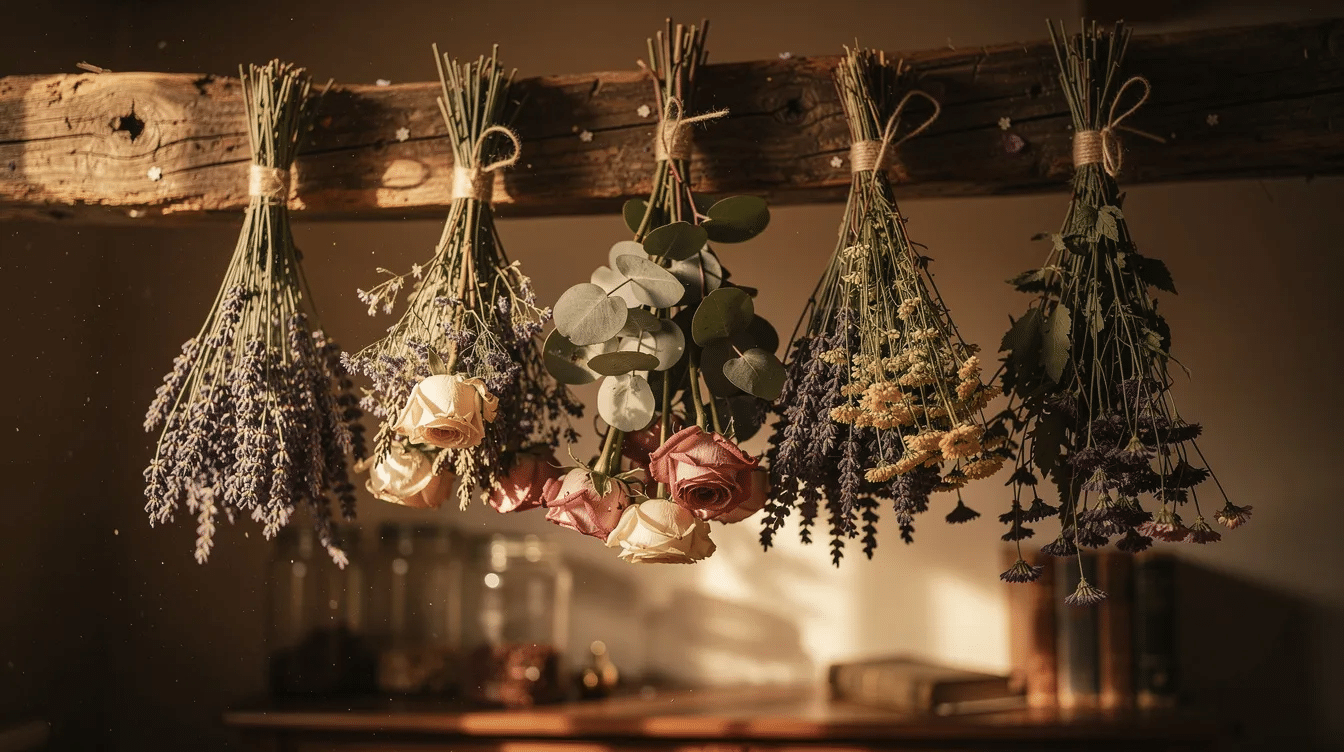
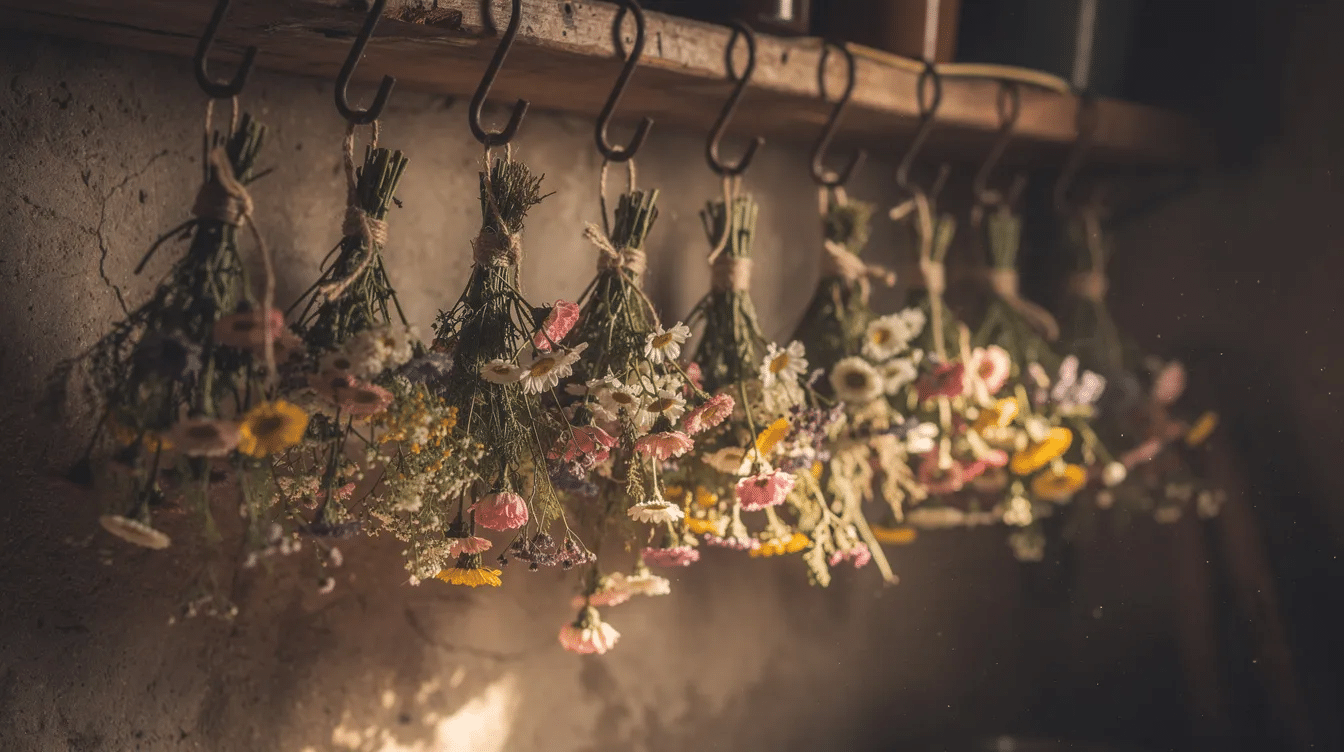
Hang the bundles upside down. Use hooks, a clothes rail, or a length of string stretched between two points. Space bundles so they do not touch each other or nearby surfaces. Contact leads to flattened petals and mold.
Wait and check. Air drying takes 2 to 3 weeks for most flowers, and up to four weeks for larger or more moisture-rich varieties. You will know they are ready when stems snap rather than bend, petals feel dry and papery, and colours have stabilised.
Optional finishing step. Once flowers are completely dry, a light mist of unscented hairspray or an artist’s fixative reduces shedding and strengthens fragile petals. Spray dried flowers with unscented hairspray for protection – hold the can at arm’s length and apply a thin, even coat. This is especially helpful for delicate specimens like baby’s breath and larkspur.
Setting Up the Perfect Air Drying Space at Home
The right environment matters more than having a dedicated studio. A dark, dry, ventilated space is all you need, and most homes already have one hiding in plain sight.
Here are a few realistic setups:
Spare bedroom or guest room: hang flowers from a curtain rod or tension rod installed across a window (keep curtains drawn for darkness).
Loft or attic: natural warmth and low humidity make these ideal, provided there is some air movement.
Garage or shed: install hooks along a beam; just ensure the space is dry and free from pests.
Wardrobe or closet: surprisingly effective for small bunches – hang them from the rail with S-hooks and leave the door slightly ajar for airflow.
Ideal conditions bear repeating: normal room temperature, low humidity (avoid bathrooms and damp basements), no direct sunlight, and enough air movement to prevent stagnant, moisture-laden pockets around the blooms.
Simple tools make the process smoother. Wooden pegs or S-hooks, jute string, and labelled tags noting the flower type and date cut (for example, “Lavender, July 5, 2026”) help you track progress and plan future harvests.
For very small spaces, you can dry small bunches inside a ventilated cardboard box with air holes punched in the sides, stored upright in a wardrobe. And one safety note: if drying near a kitchen or any heat source, keep flowers well away from open flames, stovetops, and radiators. Dried plant material is highly flammable.
Air Drying vs. Other Drying Methods (Silica, Pressing, Microwave)
Air drying is one of several ways to preserve flowers, and each method has its strengths. Choosing the right one depends on the flower type, the result you want, and how much effort you are willing to invest.
Method
Time Required
Best For
Trade‑offs
Air drying
2–3 weeks
Sturdy blooms, bouquets, grasses
Some colour loss; requires space
Silica gel
3–7 days
Delicate flowers, colour preservation
Costs more; needs airtight container; more silica gel required for larger blooms
Microwave
Minutes
Quick single-bloom preservation
Risky; uneven results; suited to experienced crafters
Flower press
1–3 weeks
Flat botanical art, bookmarks, cards
2D only; not for 3D arrangements
Vase drying
1–2 weeks
Hydrangeas specifically
Minimal effort but limited to certain species
Silica gel drying takes 3 to 7 days for flowers to dry and preserves shape and colour far better than air drying, making it the go-to method for many flowers that are too delicate for hanging. But it requires purchasing desiccant and using sealed containers. Microwave drying takes just minutes to dry flowers, but the risk of browning or over-drying is high.
A flower press produces beautiful flat specimens for framed art and stationery, especially if you follow a dedicated guide on how to press flowers in a book like a pro, but it cannot create three-dimensional arrangements. And vase drying is best for hydrangeas with minimal effort – simply place stems in a vase with a few centimetres of water and let it evaporate naturally.
Consider everyday scenarios: preserving a single graduation rose quickly calls for silica gel, while filling a vase with dried statice for the living room is a natural fit for air drying, and creating a pressed flower journal page requires a flower press.
Using a Flower Press Alongside Air Drying
Air drying and flower pressing complement each other beautifully. Use air drying for three-dimensional stems destined for vases and bouquets, and pressing for flat, two-dimensional blooms that work in framed art, cards, and stationery.
A flower press consists of two boards tightened with screws or straps, with layers of blotting paper and cardboard sandwiched inside. You place individual flowers or leaves between the absorbent sheets, tighten the press, and wait one to three weeks. Pressing flowers can cause discoloration due to natural dyes leaching into the paper, so changing the absorbent layers after the first few days helps maintain cleaner colours.
How to decide which route to take: thinner petals – daisies, pansies, ferns, individual herb leaves – press well. Thicker, three-dimensional blooms like roses, hydrangeas, and strawflowers are better suited to air drying or silica gel.
A lovely project idea: create a matching set from one garden harvest. Air dry a bouquet of larkspur, grasses, and roses for a vase, then press a few complementary blooms – perhaps pansies and fern fronds – for a framed piece that hangs on the wall beside it. The pairing ties a room together while celebrating the same season’s growth.
Creating a Bouquet of Air Dried Flowers
Arranging dried flowers is very similar to arranging fresh flowers, with a couple of important handling differences: stems are more brittle, petals can shed if jostled, and you obviously will not add water to the vase.
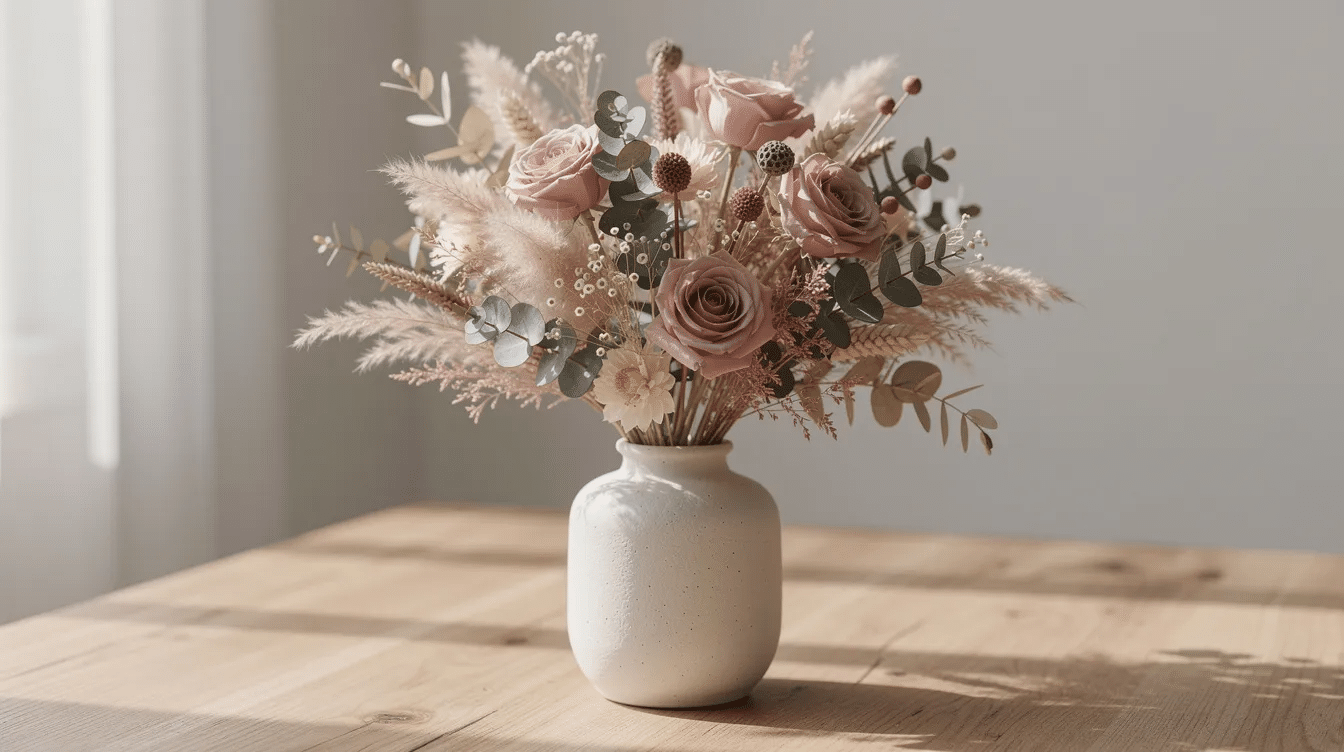
Start by building structure. Use dried grasses, seed heads, and sturdier stems as the framework. These give the bouquet height and volume. Then layer in focal flowers – dried roses, dried hydrangeas, or strawflowers – at varying heights to create visual depth.
Colour is where things get fun. For a muted, neutral look, stick to undyed tones: cream strawflowers, wheat, bunny tail grass, and white statice. For a richer palette, combine naturally vivid choices like dried larkspur (slate blue), pink globe amaranth, and deep burgundy amaranth.
Here are two concrete recipe ideas for 2026:
Neutral autumn bouquet: bunny tail grass, dried wheat, white statice, cream strawflowers, a few poppy seed heads.
Colourful summer mix: dried lavender, pink globe amaranth, blue larkspur, a couple of deep red roses, wisps of ornamental grass.
Baby’s breath is popular for dried flower arrangements and works as a versatile filler in either palette, adding airiness and softening transitions between larger blooms.
To finish: wrap the gathered stems tightly with floral tape, cover with linen ribbon or jute twine, and trim the base evenly so the bouquet stands upright in a vase. Avoid overcrowding – fewer stems with breathing room between them look more polished than a dense, crammed bundle.
Designing a Dried Flower Arrangement for Your Home
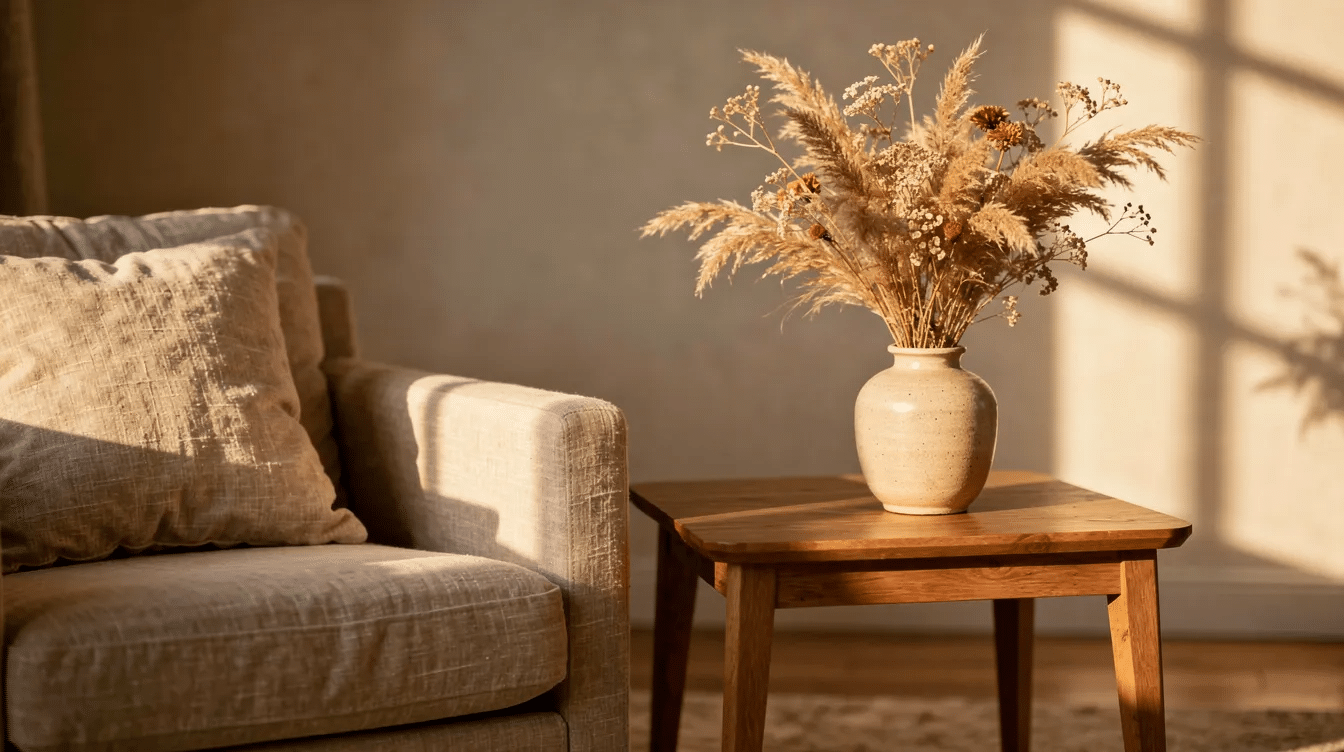
A well-designed dried flower arrangement can serve as a long-term focal point in your home decor, holding its own for months or even years without the maintenance that fresh cut flowers demand. Dried flowers can be displayed in vases for home decor across living rooms, hallways, bedrooms, and entryways.
Choosing the right vessel matters. Tall, narrow cylinders suit long grasses and larkspur spikes. Wide urns and pitchers accommodate the full, rounded heads of dried hydrangeas. Low bowls work for compact designs built on a base of floral foam or crumpled chicken wire.
A few simple design principles go a long way:
Vary height and texture within each arrangement.
Use odd numbers of focal blooms (three roses, five hydrangea heads) for a more natural look.
Leave some negative space – modern dried arrangements breathe rather than overflow.
A strong 2026 trend is the minimal Scandinavian-style dried arrangement: a handful of pale grasses, a few stems of bleached ruscus, and a single accent like dried lavender in a matte ceramic container. It is understated, elegant, and fits nearly any interior.
For placement, think console tables, bedside surfaces, mantlepieces, and open shelving. Avoid spots with intense sun or high humidity – near bathrooms, above dishwashers, or directly in front of south-facing windows. Heat sources like radiators can also make stems excessively brittle over time.
Wedding & Keepsake Ideas with Air Dried Flowers
The popularity of dried flower weddings has surged from 2023 through 2026, driven by sustainability goals, boho-chic aesthetics, and the practical advantage that floral arrangements can be prepared months in advance.
Options for using air dried florals at weddings include:
A bridal bouquet of dried lavender, roses, and grasses – soft, lightweight, and unlikely to wilt during a long ceremony.
A wedding bouquet built from dried hydrangeas, statice, and bunny tail grass for a textured, romantic feel.
Dried flower crowns for flower girls or bridesmaids.
Boutonnières featuring a single dried rose or a sprig of eucalyptus.
Aisle markers and table centerpieces using coordinated dried bundles.
If your event is in late 2026, start air drying flowers two to three months beforehand. This gives you time to build a consistent colour palette and accumulate enough stems. Label and store finished bundles carefully so colours and varieties stay organised.
After the celebration, wedding flowers can live on as keepsakes. A dried flower shadow box displaying the bridal bouquet, a resin block encasing a single dried rose, or a framed combination of air dried petals and pressed flowers all make lasting mementos. Even previously dried bouquets can be disassembled, reshaped, and incorporated into new keepsake designs years later – the beauty of dried and preserved flowers is their enduring adaptability.
Creative DIY Projects with Air Dried Flowers
Once you start drying flowers, you will quickly accumulate small stems, stray petals, and tiny blossoms that are perfect for crafts. Rather than discarding these offcuts, put them to work.
Here are some favourite projects:
Potpourri bowls: dried flowers can be used to create potpourri by combining dried rose petals, lavender, and herbs with a few drops of essential oil; if you want perfectly textured petals for this, follow a guide on how to dehydrate rose petals at home. Scent lasts six to twelve months; refresh with more oil as needed.
Dried flower candles: press small dried petals against the outside of a pillar candle using a warm spoon or heat gun for a botanical surface decoration.
Wax sachets: melt soy wax into a silicone mould, embed tiny dried blooms on the surface, and add a ribbon loop for hanging in wardrobes.
Herbal bath salts: dried flowers can be used to create herbal bath mixes – combine dried rose petals and lavender with Epsom salts and essential oils for a simple bath soak, much like you would when drying fresh basil for long-term use to infuse culinary or self-care recipes with homegrown botanicals.
Botanical bookmarks: glue small air dried petals or pressed flowers onto card stock, seal with clear adhesive film, and trim; oven drying can be handy when you want to dry flowers in the oven step-by-step for quick crafting sessions. Dried flowers can also enhance gift wrapping when tucked under ribbon or twine.
Flower wreath: gather a wire or grapevine base and attach small bunches of dried blooms and grasses to create beautiful wreaths for doors or walls, or expand the idea into dried Christmas floral arrangements for holiday decor that can be enjoyed year after year. Dried flowers can be used in various crafts including wreaths and framed art.
Jewelry: dried flowers can be used to make unique jewelry pieces – tiny blooms or petals encased in resin pendants or locket-style rings.
Date and label your creations, especially when using dried herbs in potpourri or sachets, because scent fades over six to twelve months and you will want to know when to refresh; the same habit helps when making DIY dried fruit potpourri at home so you can track blends and seasonal experiments.
Care and Maintenance of Air Dried Flowers
Keeping a dried flower arrangement looking its best requires very little effort, but the few rules that exist are non-negotiable.
The golden rules:
Never add water. Dried blooms and moisture do not mix – even a small splash can cause mold.
Air-dried flowers should be kept away from direct sunlight to prevent fading. UV light bleaches colours, especially reds and pinks.
Avoid exposing dried flowers to direct sunlight and humidity. Damp air softens stems, invites mildew, and shortens lifespan significantly.
For dusting, dust dried flowers gently with a feather duster or paintbrush. A soft-bristled paintbrush is ideal for getting between tightly packed petals. Alternatively, use a hair dryer on a cool, low setting held at arm’s length to blow off surface dust without disturbing fragile structures.
Position arrangements away from radiators, fireplaces, kitchen steam, and constantly open windows that create strong, drying drafts. The ideal spot is a sheltered area with stable temperature and low ambient moisture.
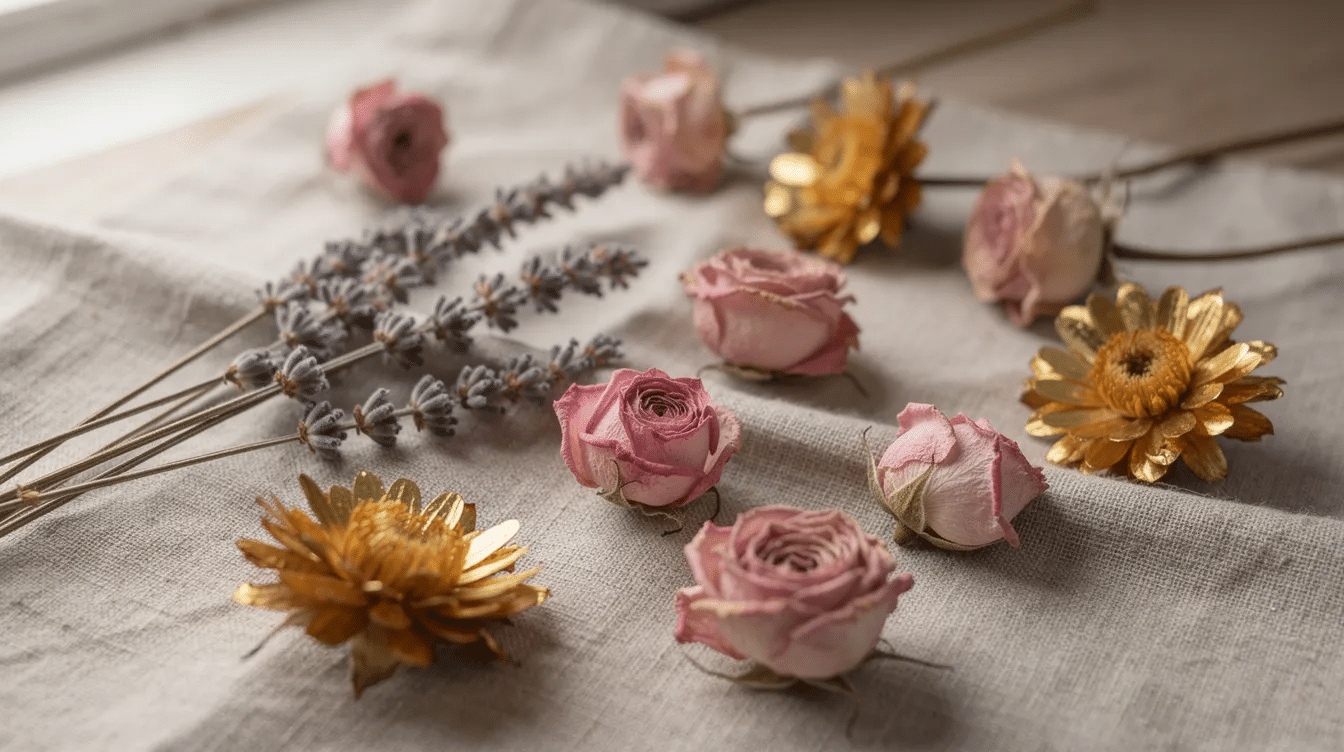
Colour will gradually soften over months. Rather than viewing this as a flaw, many people appreciate the deepening patina as part of the charm. Very faded stems can be retired from display and reused in crafts – potpourri, confetti, or wax projects are all good second lives for blooms past their visual prime.
How Long Do Air Dried Flowers Last?
Most air dried flowers last between 1 and 3 years with proper care. Some delicate types sit closer to the one-year mark, while robust varieties regularly exceed that window.
Longevity by type:
Grasses and seed pods: often last three years or more with minimal fading.
Dried lavender, statice, and strawflowers: two to three years is typical.
Dried hydrangeas and roses: can become brittle sooner, especially in variable indoor climates; expect roughly one to two years of display life.
The main factors that shorten lifespan are strong sunlight, high humidity, frequent handling (by children or pets), and heavy dust build-up. Store dried flowers in a cool, dry, dark place when they are not on display, and they will last significantly longer.
A useful habit: early each spring, review your arrangements. Remove very damaged or brittle stems, and refresh the display with new air dried blooms from the coming season. This yearly rotation keeps everything looking intentional rather than neglected.
For sentimental pieces like a wedding bouquet, parts can often be transferred into a shadow box or preserved in resin once the original arrangement becomes too fragile for open display. This way, the memory endures even after the flowers themselves have reached the end of their natural life.
Common Problems When Air Drying Flowers (and Fixes)
Small issues like slight browning or a little petal shedding are completely normal. Most problems have straightforward solutions, and understanding the causes helps you prevent them next time.
Browning and fading. The most common culprit is too much light – air-dried flowers can lose some of their original color during the drying process, and continued UV exposure accelerates fading. Over-mature flowers harvested past their peak also brown more readily. The fix: cut earlier, and always dry in a dark space. Once fade has occurred, it is permanent, though you can embrace it or move pale stems into neutral, monochrome arrangements.
Mold and mildew. Damp spaces and overcrowded bundles are the usual causes. If you spot mold on any stem, discard it immediately – mold spreads quickly. Improve airflow, reduce bundle size, and ensure your drying space stays below 50% relative humidity.
Drooping or misshapen stems. Some thin-stemmed flowers need support during drying. Thread florist wire through or alongside the stem before hanging, or rest large flower heads face-up on a wire mesh screen. This preserves their natural shape without flattening.
Practical scenario: imagine a July 2026 lavender bunch that becomes limp during a humid heatwave. Move it to the driest room in the house, reduce the bundle to three or four stems, point a fan at it from a distance, and check daily. Most bunches recover within a few days once humidity drops.
If stems snap cleanly after the adjustment period, they have dried properly. If they still bend, give them more time.
Safety & Allergen Considerations for Dried Flowers
Dried flowers are generally low-maintenance, but they still bring plant material indoors, so it is worth considering allergies and safety.
Most pollen is shed by the time flowers are fully air dried, making them friendlier for allergy sufferers than fresh bouquets. However, highly sensitive individuals may still react to dust that accumulates on dried arrangements or to residual pollen trapped in dense flower heads. To minimise exposure, consider displaying dried blooms under glass cloches, domes, or inside a sealed shadow box – particularly in bedrooms or nurseries.
For households with pets or young children:
Avoid placing fragile dried arrangements where they can be knocked over, chewed, or played with.
Some plants, like eucalyptus, can be toxic if ingested by pets. Keep these species out of reach.
Brittle stems and shattered petals can be a choking hazard for very small children.
Before bringing dried stems indoors – especially if they were dried in sheds, garages, or outbuildings – inspect them briefly for insects. Dermestid beetles and small moths are occasional hitchhikers on dried plant material and can cause damage to other textiles in the home.
Sourcing Flowers for Air Drying: Garden, Market & Foraging
There are three main routes to sourcing flowers for air drying: your own garden, local markets, and carefully considered foraging.
Home gardens. Planting a small “dry flower” patch is the most rewarding long-term approach. In spring 2026, sow or plant lavender, statice, strawflower, larkspur, yarrow, and ornamental grasses. Many flowers from even a modest bed will yield enough material for several dried arrangements by late summer. Amaranth and yarrow are also great choices for drying and both grow well in most temperate gardens.
Markets and florists. A farmers market is an excellent source of locally grown, seasonal stems. When buying, look for flowers that are fresh, firm-petalled, and at the right stage of bloom for drying – not already fully open or drooping. Ask the grower about pesticide use if you plan to use any blooms in cosmetics or food-related crafts. Some dried flower farms even sell pre-dried bundles and ships nationwide for those who lack garden space.
Foraging. Wild grasses, seed heads, and herbs can make beautiful additions to dried arrangements. However, never pick protected species, respect private land, and take only a small portion of any wild stand to allow regrowth.
Sourcing from local, sustainable growers helps reduce transport emissions and supports small flower farms that often specialise in dried and preserved flowers, and you can apply the same ethos when you dry hibiscus flowers for teas and crafts using homegrown or ethically sourced blooms. It is a simple way to make your hobby more environmentally responsible.
Color & Texture: Designing with Naturally Air Dried Tones
Air dried flowers shift in colour as they dehydrate, often becoming softer, more antique-looking versions of their fresh selves. Understanding these shifts helps you plan palettes with confidence.
Typical colour changes:
Red roses deepen to burgundy or dark wine.
Pink hydrangeas turn dusty mauve or sage.
Blue larkspur softens to slate blue or grey-blue.
Yellow strawflowers hold their warm tone surprisingly well.
White blooms may develop a cream or ivory patina.
If you want stronger dried colour, start with brighter fresh blooms. If a muted, neutral palette is your goal, choose flowers that are already soft-toned on the plant – pale pink roses, cream statice, or silver-grey eucalyptus.
Texture is equally important in dried flower design. Crisp strawflowers contrast beautifully with feathery grasses, papery statice adds volume without weight, and structured seed pods like poppy heads provide architectural interest. Mixing textures prevents arrangements from looking flat or one-dimensional.
It is worth noting that some commercially available dried flowers are bleached or dyed. This article focuses on the look of naturally air dried flowers without chemical treatment. If you do encounter dyed stems and want to combine them with natural ones, test how the colour holds over time – some natural dyes fade unevenly and can look patchy within a few months.
Sustainable & Eco‑Friendly Aspects of Air Dried Flowers
Dried flowers have become a quiet pillar of sustainable living and slow decorating in the mid-2020s, and air drying sits at the heart of that movement.
Air drying is a chemical-free and natural preservation method that uses minimal energy. Unlike oven or microwave methods, there is no electricity involved. You are simply harnessing warm, dry air and patience. Every bloom you dry is one fewer stem discarded after a week on the kitchen table.
Growing your own flowers for drying – from 2026 seed sowings onward – cuts transport emissions and packaging compared to imported fresh flowers, which according to Clemson University’s extension service often travel thousands of miles before reaching a consumer’s vase.
The lifecycle of air dried flowers is inherently circular:
Grow or source locally.
Air dry and enjoy for one to three years.
Repurpose faded stems into crafts, potpourri, or confetti.
Compost spent material back into the garden.
Concrete actions you can take: choose seasonal flowers over imported ones, support small sustainable flower farms, avoid plastic-wrapped artificial arrangements when long-lasting air dried flowers would serve the same purpose, and compost dried plants when they finally reach the end of their useful life.
Storing Air Dried Flowers You’re Not Displaying
Not every dried stem needs to be on display at all times. Proper storage preserves quality for future projects and seasonal rotations.
To store whole stems:
Loosely wrap small bunches in acid-free tissue paper.
Place them in sturdy cardboard boxes, separated by layers of tissue to prevent crushing.
Label each bundle with the flower type and harvest date – “Statice, August 2026,” for example.
Storage conditions should mirror drying conditions: a dry place that is cool, dark, and away from exterior walls where condensation can form. The top shelf of a wardrobe, a spare cupboard, or an interior closet all work well. Avoid garages or sheds unless they are reliably dry and pest-free.
For especially fragile or valuable dried flowers – pieces from a bridal bouquet, for instance – use rigid containers or shallow shadow boxes with lids. This prevents accidental crushing and keeps dust and insects out.
Check stored flowers every few months. Look for signs of moisture (softening stems, musty smell), mold (white or grey fuzz), or insect activity (small holes, fine dust). Remove any compromised stems promptly to prevent problems spreading to the rest of the collection.
Over time, dried arrangements from previous seasons may start to look tired. Faded colour, a few broken stems, or accumulated dust can take the sparkle out of what was once a stunning display. But do not reach for the bin just yet – most dried flowers can be refreshed rather than discarded.
Start by gently disassembling the old arrangement. Lay stems out on a clean surface and sort them: keep anything that still has good structure and reasonable colour, and set aside anything that is broken, very faded, or dusty beyond rescue.
Mix older dried stems with new 2026 air dried flowers to create updated palettes and textures while retaining a sense of continuity. A handful of fresh dried larkspur or a few new grasses can transform a two-year-old arrangement into something that feels current again.
For stems that are past their display life, consider these upcycling ideas:
Crumble brittle blooms into potpourri and add a few drops of essential oil.
Break down seed heads for use in wax sachets or craft projects.
Press any salvageable petals in a flower press for bookmarks or cards.
Treat this as a seasonal ritual. Each spring or early summer, revisit your dried flower décor. Retire what needs retiring, plan your next round of air drying, and keep the cycle going. It keeps your home feeling fresh and intentional without generating waste.
Conclusion: Bringing Air Dried Flowers into Your Everyday Life
Air drying flowers is one of those rare hobbies that asks very little of you and gives back generously. A dark room, some twine, a bit of patience, and you have blooms that last years instead of days. No special equipment, no chemicals, no ongoing cost.
Whether your starting point is a single bunch of dried lavender on a kitchen shelf, a bouquet of dried roses saved from a birthday celebration, or a full wreath crafted from a summer garden harvest, the process is the same – and it works.
Each season will teach you something new. You will discover which plants in your garden and climate air dry best, which colour shifts you love, and which arrangements make your spaces feel most like home. The beauty of working with nature is that no two batches are ever quite the same.
So here is the invitation: pick one flower, one method, and one project from this guide, and try it within the next week. Hang a small bunch of lavender in a spare room. Tie up a few rose stems with rubber bands and tuck them into a closet. Watch the slow, quiet magic of air and time turning something fleeting into something lasting.
Frequently Asked Questions About Air Dried Flowers
Below are answers to some of the most common questions that were not fully covered in the sections above.
Can I restore the color of faded air dried flowers?
Natural fading is permanent – once pigments break down, they cannot be reversed. However, you can enhance colour by carefully misting stems with floral spray paint, lightly brushing with artist pastels, or using a very dilute fabric dye misted from a distance. Always test on a spare stem first, and work outdoors or in a well-ventilated area to avoid inhaling particles.
Keep the finish light and natural-looking. Heavy-handed application makes dried flowers look artificial, which defeats the purpose. Many crafters choose to embrace the fade instead, moving very pale stems into neutral, monochrome arrangements where their softened tones become a design feature rather than a flaw.
Do air dried flowers still smell?
Some flowers retain a gentle scent for several months after air drying. Dried lavender, roses, and herbs like rosemary or mint are the strongest performers – lavender in particular can hold its fragrance for well over a year in a warm, enclosed space like a drawer sachet.
Fragrance does fade over time. You can boost it by placing a drop or two of matching essential oil on the stems or mixing it into potpourri. Avoid applying oil directly onto delicate petals, as it can cause discolouration or softening. If you notice musty or sour odours rather than floral scent, that usually signals moisture or mold – discard those stems immediately.
Can I air dry supermarket bouquets?
Yes, many supermarket bouquets can be air dried successfully. Roses, chrysanthemums, statice, and baby’s breath from shop-bought bunches often produce good results. Remove any stems that are already slimy or browning, and start the drying process as soon as possible after purchase for the best outcome.
Be aware that some store-bought flowers are heavily treated with preservatives or dyed, which may affect how they dry – colours can shift unpredictably, and treated stems sometimes develop an unusual texture. Experiment with a small test bunch first before committing a whole bouquet to drying.
Are air dried flowers safe to use in cosmetics or teas?
Only flowers grown without pesticides and specifically intended for culinary or cosmetic use should go into teas, bath products, or skincare. Decorative dried flowers from florists or craft suppliers are often treated with preservatives, dyes, or pesticides and should never be ingested or applied to skin.
For edible or topical projects, source organic culinary-grade dried flowers – such as calendula, chamomile, or rose – from reputable food or herbal suppliers, just as you would choose food-safe leaves when you dehydrate basil in an air fryer for cooking. These are grown and processed to food-safety standards, which general decorative blooms are not.
What should I do with broken or shedding dried flowers?
Do not throw them away immediately. Collect loose petals and small fragments in a jar – they make excellent raw material for potpourri, confetti, wax sachet decoration, or craft projects down the line.
Damaged stems can be trimmed shorter and repurposed in smaller bud vases, compact wreaths, or place-card decorations where imperfections are less noticeable; they are also perfect for tucking into dried flower bathroom decor ideas where small, low-maintenance accents make a big impact. Once pieces are too dusty or deteriorated for any further use, they can be composted like any other plant material, returning nutrients to the soil and closing the loop sustainably.
DannyContent Writer
Hey there, since 2016, my mission has been to provide you with the information and guides you need to make food dehydrating simple and fun. Whether you're a newbie or a seasoned pro, my site offers helpful guides, reviews, and recipes to enhance your dehydrating experience. I take pride in only recommending products I believe in, ensuring my readers' trust. As an affiliate of various programs, including Amazon Associates, your support helps me continue providing quality content. Thanks for stopping by, and happy dehydrating!