We earn a commission if you make a purchase, at no additional cost to you.
09/22/2026 04:39 pm GMT
🍊 Dehydrated Food Info Finder — Temperatures & Drying Times
Choose a category, then pick a food to see its drying temperature and time.
⚠️ Safety Disclaimer: Drying times are estimates and vary based on slice thickness, food moisture content, humidity, and your dehydrator model. Always check for doneness before storing — food should feel dry, leathery, or brittle with no moist spots. Improperly dried food can harbour mould and bacteria. For meat and poultry, follow USDA safe internal temperature guidelines: beef and pork to 160°F (71°C), poultry to 165°F (74°C). Use a food thermometer when in doubt. Store all dehydrated foods in airtight containers in a cool, dark place and discard anything showing moisture, mould, or off odours.
Pineapple Zucchini: Dehydrated “Faux Pineapple” Candy From Garden Zucchini
If your garden keeps producing more zucchini than you can possibly eat fresh, this recipe turns that surplus into something genuinely delicious: chewy, sweet pineapple zucchini candy made with a home dehydrator. The process is simpler than you might expect, and the finished product tastes remarkably close to the real thing.
Key Takeaways
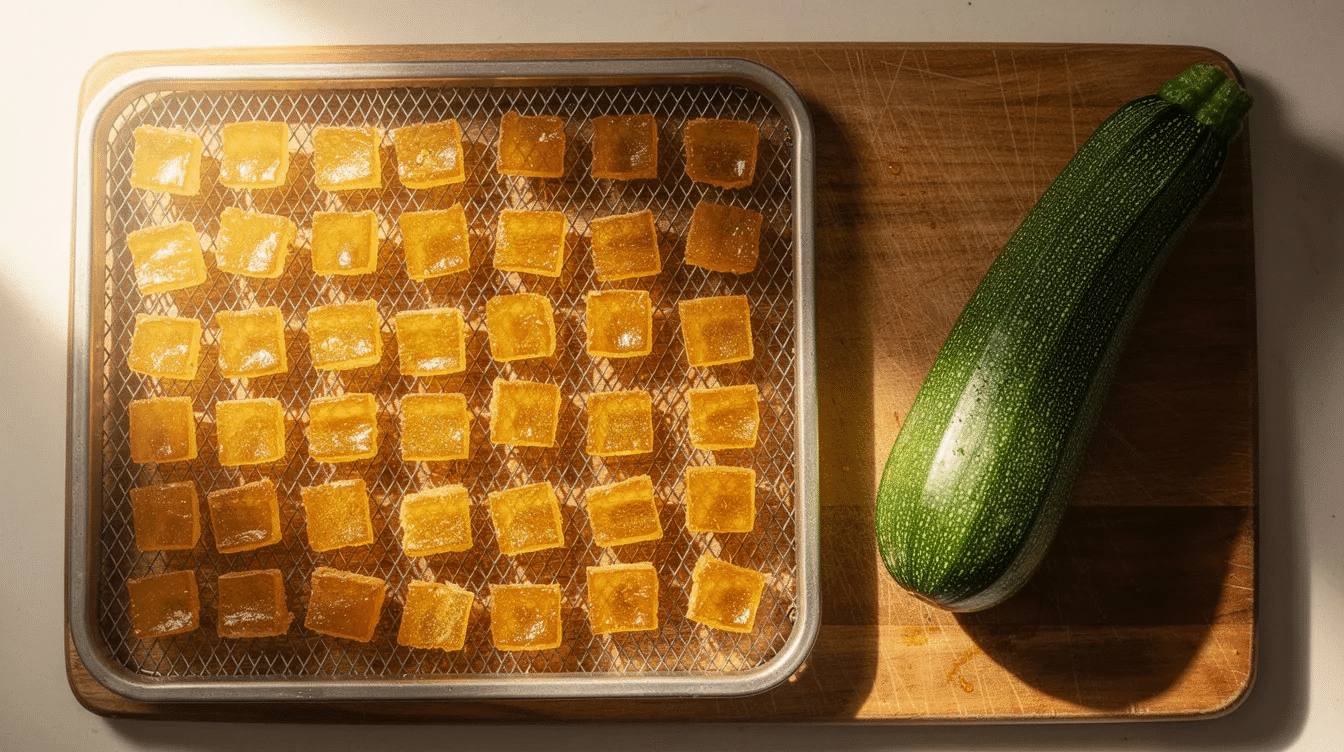
This faux pineapple recipe transforms garden zucchini into a chewy, shelf-stable candy by simmering cubes in pineapple juice, lemon juice, and sugar, then dehydrating at 125–135°F for 12–18 hours.
The method is ideal for using up oversized zucchini squash during the summer harvest season (July–September) and works as an alternative or companion project to home canning pineapple zucchini.
Dehydrated zucchini can mimic the taste of pineapple so convincingly that many people can’t tell the difference, making it a budget-friendly stand-in for real pineapple in snacks and baking.
At Dehydrated Foodz, we focus on food preservation through dehydration, offering time-and-temperature guidance, dehydrator reviews, and equipment recommendations to help you get consistent results.
This article covers the full process from prep to storage, compares dehydrated vs. canned versions, explains safety basics, and gives usage ideas for your finished pineapple zucchini candy.
How to Make Pineapple Zucchini Dehydrated Candy: Step-by-Step Guide
Wash, peel, halve lengthwise, scoop out seeds, and cut into ½-inch cubes or preferred shapes.
Uniform pieces ensure even drying.
3. Simmer in Juice
In a large pot, combine pineapple juice, lemon juice, and sugar. Bring to a boil. Add zucchini and simmer 15–25 minutes until translucent.
Stir occasionally; reuse juice for multiple batches.
4. Drain Zucchini
Remove zucchini with a slotted spoon; drain excess liquid in a colander.
Save juice for next batch or syrup drizzle.
5. Arrange on Trays
Spread zucchini pieces in a single layer on dehydrator trays with good airflow.
Use mesh screens or non-stick sheets.
6. Dehydrate
Dry at 125–135°F (52–57°C) for 12–18 hours until pieces are dry, pliable, and not sticky.
Flip pieces midway for even drying.
7. Cool and Condition
Let cooled dried pieces sit loosely in jars for 7–10 days, shaking daily to equalize moisture.
Return to dehydrator if condensation appears.
8. Store
Transfer to airtight containers or vacuum-sealed bags; store in a cool, dark place.
Keeps best for 6–12 months.
9. Optional Coating
Toss dried zucchini with powdered sugar and cornstarch to prevent clumping.
Ideal for snacks and travel packs.
This table summarizes the pineapple zucchini dehydrated zucchini version process for easy reference and successful preservation of your garden harvest.
What Is Pineapple Zucchini (Dehydrated Version)?
Pineapple zucchini is zucchini simmered in pineapple juice and then dehydrated until chewy, producing a treat that looks and tastes remarkably like dried pineapple. Zucchini can be canned in pineapple juice or dehydrated-this article focuses on the dehydrated version, though it draws directly from the classic mock pineapple canning recipes that originated at Utah State University in the late 1970s and were later standardized by the USDA in Agriculture Information Bulletin No. 539.
Because zucchini has such a mild, neutral flavor, it readily absorbs pineapple juice, lemon juice, and sugar during simmering. The result is a convincing stand-in for canned pineapple tidbits or crushed pineapple in both snacks and baking.
There are three related versions worth knowing:
Canned pineapple zucchini – processed in a boiling water canner for pantry storage
Fresh mock pineapple – simmered and refrigerated, used within a few days
Dehydrated pineapple zucchini candy – dried to low moisture for long-term, shelf-stable storage
Dehydrated zucchini is a nutrient-dense food preservation method that extends storage life far beyond refrigeration, which is why it appeals to food preservation enthusiasts who want to preserve zucchini from a bumper crop.
Why Make Dehydrated Pineapple Zucchini Instead of Just Canning?
If you already have experience canning pineapple zucchini, the dehydrated version makes an excellent companion project-or a standalone alternative if you’d rather skip the jars and lids entirely.
Here’s why dehydrating stands out:
Uses oversized zucchini. Those baseball-bat-sized fruits with large seeds that aren’t great for sautéing become perfect raw material once you scoop out the spongy center.
Saves space. A full canning batch yields about 8 to 9 pints of zucchini pineapple in jars. The same recipe worth of zucchini, once dehydrated, fits into a couple of quart bags.
Portability. Lightweight and compact, pineapple zucchini candy is perfect for hiking, school lunches, and trail mix.
Concentrated flavor. While canned versions sit in syrup and taste like soft pineapple tidbits, dehydrated zucchini has a chewy texture similar to dried fruit-dense, sweet, and intensely flavored.
The process of dehydrating preserves seasonal fruits and vegetables for later use while retaining more of the fresh pineapple aroma compared to extended boiling. Dehydrated zucchini retains much of its nutritional value when dried, and you have flexibility to sweeten with sugar, honey, or reduced-sugar options.
Choosing and Preparing Zucchini for Faux Pineapple
Almost any garden zucchini works here, but overgrown summer squash from mid- to late-season harvests are especially well suited. Their firm, mature flesh holds up better during simmering and drying.
What to look for:
Firm zucchini, 10–18 inches long, harvested July through early September
No soft spots, mold, or excessive wax coating
Larger fruits are fine-you’ll peel zucchini and remove the seed core anyway
How to prepare zucchini:
Wash thoroughly and peel off the dark green skin for a lighter, more pineapple-like color (zucchini must be peeled before canning or dehydrating for this recipe)
Halve lengthwise and scoop out any large, mature seeds from the center
Cut into ½-inch cubes to resemble pineapple tidbits, or use thin half-moons for faster drying, or coarse shreds for candy “strings”
Keep pieces uniform in size-consistent cuts ensure even dehydration
A sharp chef’s knife or mandoline slicer speeds prep significantly when you’re working through a bumper crop. You can also use chopped or shredded zucchini depending on your preferred finished texture.
Ingredients for Pineapple Zucchini Candy
These quantities are for a typical home batch yielding roughly 6–8 dehydrator trays, not for water bath canning.
Powdered sugar mixed with cornstarch or tapioca starch for a light anti-stick coating on the finished candy
If you run short on pineapple juice, you can substitute part with apple juice, though the pineapple flavor will be softer. For recipes calling for even more tropical punch, a tablespoon of pineapple extract works well.
Step-by-Step: Simmering Zucchini in Pineapple Juice
This stage infuses the zucchini with pineapple flavor before it goes into the dehydrator. The liquid can be reused across multiple batches until it becomes thick and syrupy.
Setup: Choose a large pot or large saucepan with a heavy bottom. Pour in enough pineapple juice to fully cover the zucchini pieces and stir in the lemon juice and sugar until dissolved. Bring to a boil over medium heat.
Cooking: Add the prepared zucchini cubes to the juice. Bring slowly back to a gentle boil, then reduce heat and simmer for 15–25 minutes, stirring occasionally, until the zucchini turns translucent and looks like cooked pineapple tidbits. For the canning version, you simmer zucchini in pineapple juice for 20 minutes before processing. The dehydrated version follows the same simmer range-just enough to infuse flavor without turning pieces to mush.
Draining: Remove the zucchini with a slotted spoon, transferring pieces to a colander set over a bowl. Let excess liquid drain back so you can reuse the remaining juice for a second round of zucchini. People who love pineapple sometimes cook the leftover syrup down further to drizzle over the dried candy.
Safety note: Keep the pot at a steady simmer throughout. Discard any batch that smells off, and avoid drastically extending cook time-overcooked zucchini becomes too soft to dehydrate evenly.
Dehydrating Pineapple Zucchini: Time, Temperature, and Texture
This is the core technique for turning mock pineapple into shelf-stable dehydrated zucchini candy. Getting the temperature of your dehydrator right makes all the difference.
Pre-drying setup: Arrange hot, drained zucchini cubes in a single layer on dehydrator trays lined with mesh screens or non-stick dehydrator sheets. Leave small gaps between pieces for air circulation.
Settings:Dehydrate zucchini at 130 degrees for about 18 hours. The recommended range is 125–135°F (52–57°C). Lower temperatures around 125–130°F preserve flavor best, while the higher end speeds drying but may cause browning. Washington State University extension testing found that 14 hours at 125°F with a flip midway produced good results, though thicker cubes often need the full 18 hours.
How to tell when it’s done: Pieces should be dry to the touch, pliable but not sticky, with no visible moisture when broken open. Larger cubes feel like firm gummies rather than brittle chips. If pieces stick to your fingers, they need more time.
At Dehydrated Foodz, we recommend using a quality dehydrator with an adjustable thermostat and strong horizontal airflow. If you’re still choosing equipment, our top dehydrator reviews and breakdown of the best food dehydrators can help narrow your options.
Cooling, Conditioning, and Storing Dehydrated Zucchini Pineapple
Proper post-drying handling prevents mold and extends storage life-an often-overlooked step in food preservation.
Cooling: Let trays sit at room temperature until pieces are completely cool before packaging. Sealing warm candy creates condensation inside containers, which invites mold.
Conditioning: Place dried pieces loosely in clean glass jars for 7–10 days. Shake daily and watch for foggy spots or clumping that signals uneven drying. If condensation appears, return the batch to the dehydrator. This conditioning process is explained in detail in our guide on how to store dehydrated food in mason jars.
Long-term storage: Transfer fully conditioned pineapple zucchini candy to airtight jars, vacuum-sealed bags, or mylar bags with oxygen absorbers. Store in a cool, dark cupboard (50–70°F) to maintain quality for 6–12 months. Dehydrated zucchini stores well in an airtight container for months when handled correctly.
Anti-stick coating: Use powdered sugar and starch to coat dried zucchini before packing-a light toss in powdered sugar mixed with cornstarch prevents pieces from clumping, especially useful for backpacking portions or lunchbox snacks.
Using Dehydrated Pineapple Zucchini in Everyday Cooking
Once you have jars of pineapple zucchini candy on hand, the options go well beyond snacking. Zucchini and pineapple complement each other in cooking due to their flavors, and dehydrated zucchini can be used alongside actual pineapple to enhance recipes even further.
Snack uses:
Straight from the jar as a sweet, chewy treat
Dehydrated zucchini can be incorporated into trail mixes for a sweet snack alongside nuts and coconut chips
Topping for yogurt, cottage cheese, or overnight oats
Baking uses:
Dehydrated zucchini can add sweetness to dishes such as muffins and breads-rehydrate briefly in warm water or juice first
Substitute for dried pineapple in quick breads, zucchini pineapple cake, or fruit-and-nut loaves (similar to how some recipes use dried peaches or other fruits)
Dried zucchini can be ground into powder for use in baking and smoothies
Creative ideas:
Fold into granola or chop into no-bake energy bites
Rehydrated zucchini can enhance tropical and sweet-and-sour flavor profiles in dishes-try it in stir-fries or curried rice
Dehydrated zucchini absorbs liquid and softens when added to soups and stews, and it can rehydrate quickly in cooking applications
For a softer texture, soak dried pieces in warm liquid for 10–20 minutes. Sliced, diced, shredded, or powdered zucchini can be used in various dishes depending on what you’re making. Check out our guide on using dehydrated foods in everyday cooking for more ideas with other veggies and fruits.
Dehydrated vs. Canned Pineapple Zucchini: Safety and Processing Times
Dehydrating and canning are different preservation methods with different safety rules. Never assume canning instructions apply to drying, or vice versa.
Canning pineapple zucchini traditionally follows a tested recipe from the USDA Complete Guide to Home Canning and the National Center for Home Food Preservation. The standard ratio calls for 4 quarts of zucchini, 46 oz of pineapple juice, 1½ cups lemon juice, and 3 cups sugar. You fill jars with the hot mixture, leave ½-inch headspace, and process jars for 15 minutes in boiling water at altitudes up to 1,000 feet (20 minutes for 1,001–6,000 ft; 25 minutes above 6,000 ft). A boiling water canner or steam canner can be used depending on your setup. The Georgia Cooperative Extension and other university programs also reference these same processing times from the Agriculture Information Bulletin and complete guide. Use ½-inch cubes or shreds of zucchini for canning, and canning zucchini pineapple yields about 8 to 9 pints per batch.
Dehydrated pineapple zucchini is not water-bath canned. Safety relies on sufficiently reducing moisture, using clean equipment, and storing properly. Because the finished product is dry rather than sealed in liquid, the low-acid concerns that led the USDA to standardize the canned version in the late 1980s are addressed differently-through moisture removal rather than acidified heat processing.
For long-term pantry storage, follow tested home canning recipes if you intend to can, and follow recommended drying temperatures plus conditioning practices for dehydrated products. Zucchini can be dehydrated to mimic pineapple flavor safely when you respect both methods on their own terms.
Tools and Dehydrator Recommendations from Dehydrated Foodz
While this recipe works in almost any dehydrator, certain features make drying large batches of more zucchini much easier and more consistent.
Key dehydrator features to look for:
Adjustable thermostat covering 95–165°F
Strong horizontal airflow for even drying across all trays
Multiple trays (9–12) to handle large summer harvests
Easy-to-clean mesh screens or fruit leather trays
If you’re serious about food preservation and plan to dehydrate veggies, fruits, jerky, and more, investing in a mid-range to high-end unit pays for itself quickly. Our best food dehydrators under $100 guide is a great starting point for budget food dehydrators for home use, and we also cover premium options for those ready to scale up.
Other helpful tools:
A large stainless-steel stockpot or large saucepan for simmering
A digital kitchen scale to track batch sizes
Glass jars with tight lids or vacuum sealer bags for storage
A mandoline slicer for uniform cuts
FAQ: Pineapple Zucchini and Dehydrated Zucchini Candy
Below are answers to common questions that go beyond what we covered above.
Can I make pineapple zucchini candy without sugar?
Yes. The primary preservative in dehydrated zucchini is low moisture, not sugar, so you can reduce or omit it. The candy will be less sweet but still taste delicious thanks to the natural sugars in 100% pineapple juice combined with bottled lemon juice. Non-nutritive sweeteners can be added after drying if desired, though they don’t provide the same syrup body during simmering that sugar does.
How long will dehydrated pineapple zucchini keep in storage?
When thoroughly dried, conditioned, and stored in airtight containers in a cool, dark place, the finished product can typically maintain best quality for 6–12 months. For the longest life, vacuum seal your jars or bags, avoid temperature swings, and always discard any pieces that show mold, off-odors, or unusual discoloration.
Can I reuse the pineapple juice for more than one batch of zucchini?
It’s common to reuse the liquid two or sometimes three times within the same preserving session. Each round becomes more concentrated and syrupy, which actually intensifies the flavor. Avoid cooling and storing partially used juice for later days. Discard the liquid once it becomes too thick, too dark, or develops any off-smell.
Do I need to blanch the zucchini before simmering it in pineapple juice?
Separate blanching is unnecessary because the zucchini is already heated thoroughly during the 15–25 minute simmer in pineapple juice. That step effectively cooks and softens the pieces before dehydrating. Extra blanching would make the texture too soft and lead to mushy pieces that are harder to dry evenly.
Can I use summer squash instead of zucchini for this recipe?
Most pale-fleshed summer squash varieties-yellow crookneck, straightneck, or similar-can be prepared with the same recipe and produce a similar faux pineapple effect when simmered and dehydrated. Avoid using winter squash, as it has different density, texture, and moisture content that doesn’t work as a convincing pineapple substitute. The mild flavor of summer squash is what makes it such a close stand-in for the real thing.
DannyContent Writer
Hey there, since 2016, my mission has been to provide you with the information and guides you need to make food dehydrating simple and fun. Whether you're a newbie or a seasoned pro, my site offers helpful guides, reviews, and recipes to enhance your dehydrating experience. I take pride in only recommending products I believe in, ensuring my readers' trust. As an affiliate of various programs, including Amazon Associates, your support helps me continue providing quality content. Thanks for stopping by, and happy dehydrating!