We earn a commission if you make a purchase, at no additional cost to you.
09/22/2026 04:39 pm GMT
🍊 Dehydrated Food Info Finder — Temperatures & Drying Times
Choose a category, then pick a food to see its drying temperature and time.
⚠️ Safety Disclaimer: Drying times are estimates and vary based on slice thickness, food moisture content, humidity, and your dehydrator model. Always check for doneness before storing — food should feel dry, leathery, or brittle with no moist spots. Improperly dried food can harbour mould and bacteria. For meat and poultry, follow USDA safe internal temperature guidelines: beef and pork to 160°F (71°C), poultry to 165°F (74°C). Use a food thermometer when in doubt. Store all dehydrated foods in airtight containers in a cool, dark place and discard anything showing moisture, mould, or off odours.
Dehydrator Stardew: Complete Guide to the Dehydrator in Stardew Valley
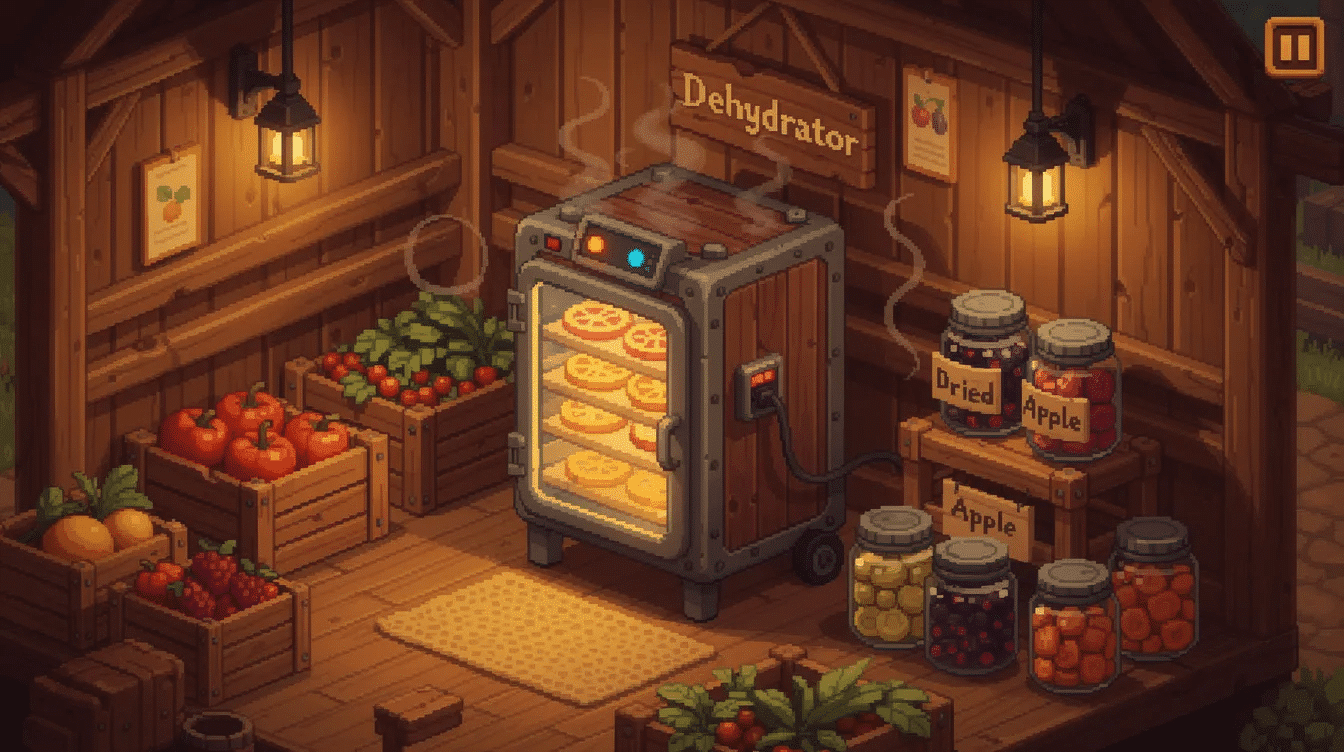
The dehydrator Stardew is an artisan machine introduced in the Stardew Valley 1.6 update that transforms fruit or edible mushrooms into valuable dried products. As a valuable upgrade for farm infrastructure, the dehydrator improves productivity by enabling rapid and efficient processing of large quantities of produce.
This guide covers everything you need to know about the dehydrator—from obtaining the recipe and gathering crafting materials to optimizing your processing workflow and comparing profitability against kegs and jars. Whether you’re in the early game looking for quick cash or managing a late-game operation with surplus produce, understanding this machine will help you make smarter farming decisions.
Direct answer: The dehydrator converts 5 identical fruits or mushrooms into dried goods worth 7.5× the base value plus 25 gold, completing the process in approximately one in-game day. Dehydrated foods restore 3 times the energy and health of the base item, making them especially useful for maintaining vitality during gameplay.
By the end of this guide, you will:
Know exactly how to obtain and craft the dehydrator
Understand the pricing formula for all dried products
Master efficient loading and processing procedures
Recognize when the dehydrator beats kegs or preserve jars for profit
Solve common challenges like clay shortages and quality matching
Disclaimer: The information provided about the dehydrator is based entirely on Stardew Valley’s game mechanics and does not reflect real-world food dehydration processes or nutritional facts.
The dehydrator functions as artisan equipment alongside kegs and preserve jars, but it fills a unique niche in your farm’s processing infrastructure. Introduced in Update 1.6, this machine accepts fruit or edible mushrooms and produces dried fruit, dried mushrooms, or raisins depending on your input—gathering the right resources is essential for maximizing the Dehydrator’s benefits.
Artisan Processing Mechanics
The dehydrator occupies a distinct position in the artisan goods economy. Unlike kegs that take approximately 7 days to produce wine or preserve jars requiring about 2.5 days for jellies, the dehydrator completes its cycle in roughly 1750 in-game minutes—basically one full day from morning to the next morning.
This speed advantage makes the dehydrator particularly valuable when you have surplus crops overwhelming your keg and jar capacity. You can process 5 blueberries, cranberries, or mushrooms and collect dried products the following morning, maintaining a rapid turnover that other machines simply cannot match—similar to how real-world dehydrators designed specifically for mushrooms quickly preserve large batches.
Product Value Calculations
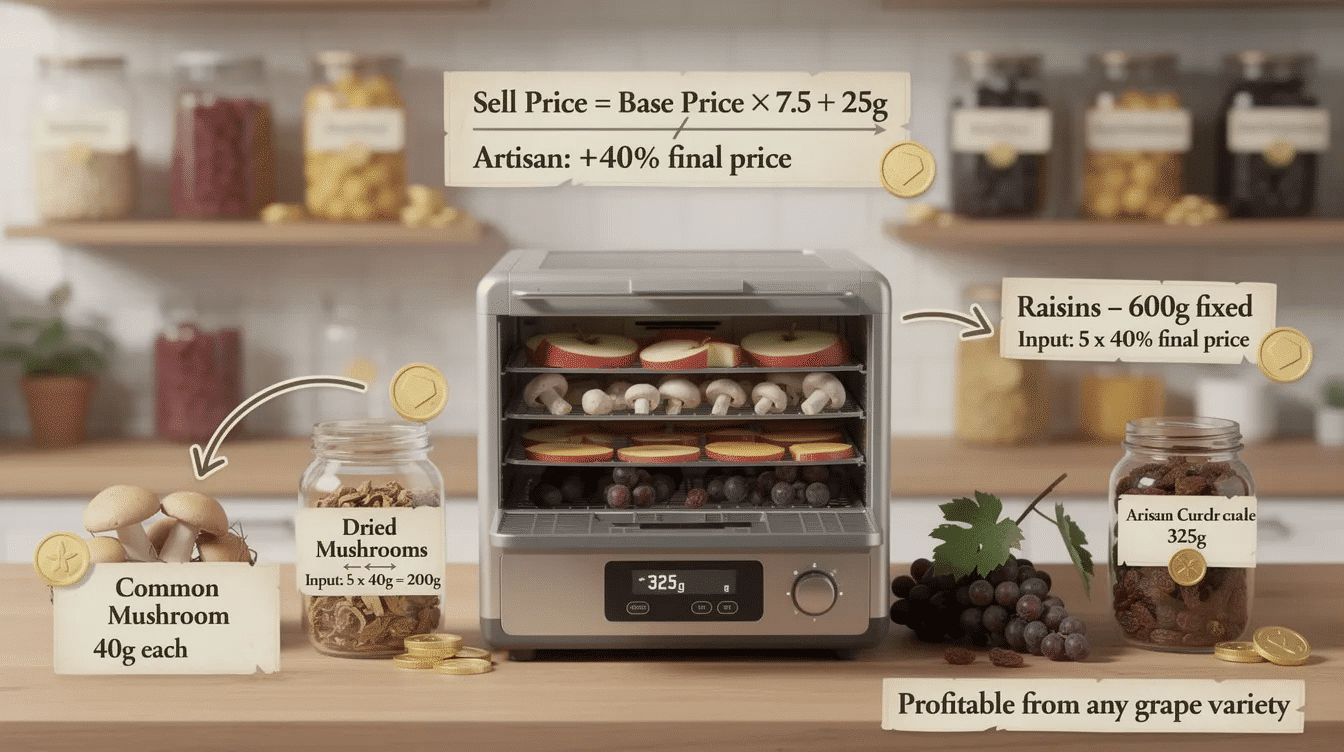
The pricing formula for dried fruit and dried mushrooms works as follows: multiply the base price of one input item by 7.5, then add 25 gold. With the Artisan profession, this final sell price increases by an additional 40%. In real life, understanding the basics of dehydrating fruit using a food dehydrator follows a similar logic of maximizing value from fresh produce.
For example, if you process 5 Common Mushrooms (base value 40g each), your dried mushrooms sell for approximately 325g base—representing a significant profit boost from the 200g total input value.
Raisins represent a special case with a fixed price of 600g regardless of grape variety. This makes grapes a consistently profitable choice when you have abundant harvests from your vineyard or fruit trees, much like making raisins in a dehydrator at home can reliably turn fresh grapes into valuable pantry staples.
Understanding these calculations helps you decide which crops deserve dehydrator processing versus shipping bin sales or alternative machines.
Obtaining Your Dehydrator
Before you can create dried products, you need access to the dehydrator recipe through one of several acquisition paths available in the game.
Purchasing the Recipe
Pierre’s General Store in Pelican Town sells the dehydrator recipe for 10,000g. This represents a significant investment, especially in the early game when gold is tight. However, there are no farming level restrictions or skill requirements—if you have the money, you can purchase the recipe immediately.
The cost pays for itself relatively quickly once you begin processing surplus harvests. A few batches of dried fruit or dried mushrooms can recoup this expense within a season if you maintain consistent production.
Alternative Acquisition Methods
Players can obtain a free dehydrator through the mushroom cave option. When Demetrius visits your farm after you’ve earned 25,000g, choosing to have edible mushrooms inside the cave rather than fruit bats rewards you with one dehydrator at no additional cost. This decision is permanent, so consider whether you prefer steady mushroom harvests over random fruit drops.
The Prize Machine at the Mayor’s Manor offers another chance to obtain a dehydrator without spending gold. There’s a 50% chance of receiving one as the 12th prize, though this method relies entirely on luck rather than guaranteed acquisition.
Crafting Requirements
Once you own the recipe, you can craft the dehydrator using the following resources, similar in spirit to assembling and running a real-world unit where efficient use of a food dehydrator and its electricity matters for long-term performance:
30 Wood – Gather this resource from chopping trees anywhere on your farm or in Cindersap Forest
2 Clay – Obtain this resource by tilling soil with your hoe, especially productive at the Ginger Island Dig Site
1 Fire Quartz – This resource can be mined from floors 80+ in the Mines, the Skull Cavern, or by cracking open Magma and Omni Geodes
Fire Quartz is typically the bottleneck resource for new players. Save any Fire Quartz you find during mining expeditions, and consider processing geodes at Clint’s shop to gather additional specimens, just as maintaining a supply of parts and know-how for troubleshooting common food dehydrator issues keeps real dehydrators running smoothly.
With these resources assembled, you’re ready to begin drying operations on your farm.
Operating the Dehydrator Effectively
Placement doesn’t affect processing speed or output quality, so position your dehydrator wherever convenient for your daily farming routine. Many players place them near storage chests containing sorted harvest or alongside other artisan machines, echoing how beginner’s guides to using a food dehydrator recommend organizing your workspace for efficient loading and unloading.
Loading and Processing Procedures
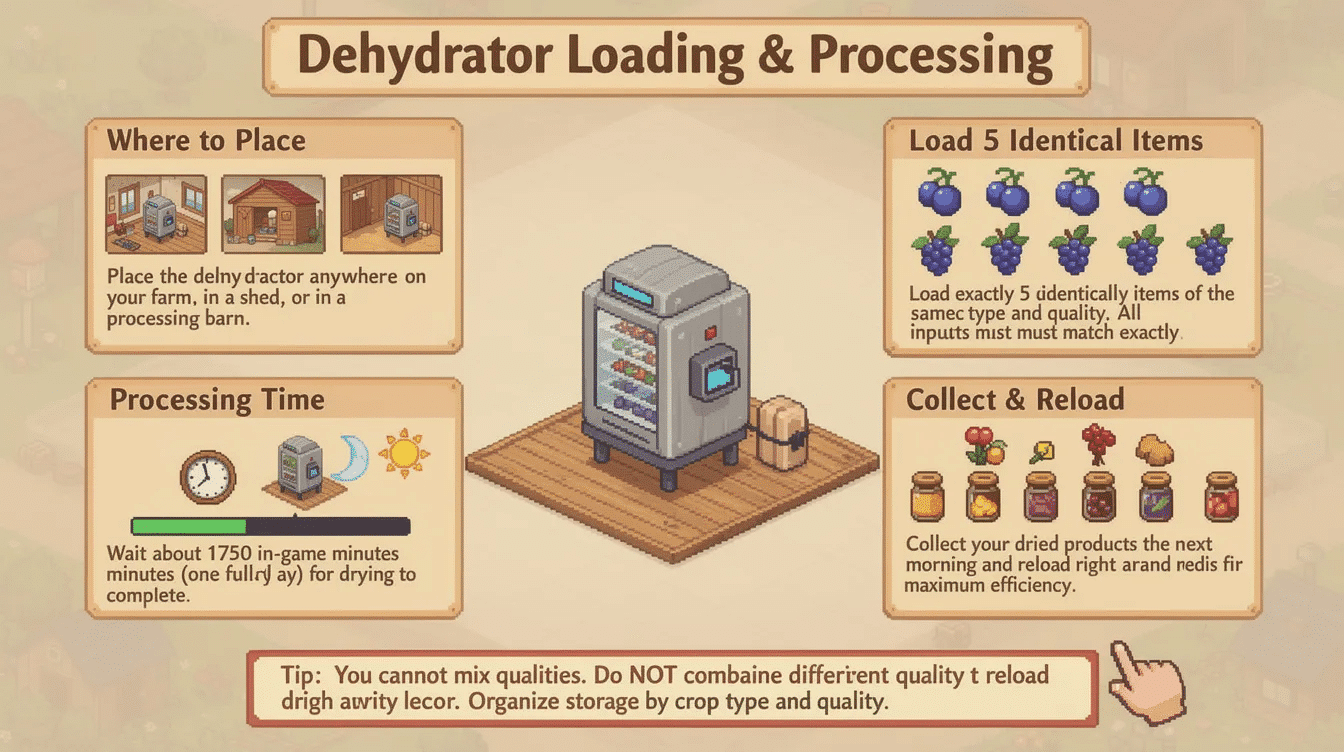
Use the dehydrator when you have 5 identical items of the same quality that you want processed quickly rather than waiting for keg or jar cycles to complete—similar to how an Excalibur dehydrator guide for fruits and jerky emphasizes batching uniform pieces for best results.
Place the dehydrator anywhere on your farm, in a shed, or inside a barn you’ve converted to processing space
Load exactly 5 identical items of the same type and quality—for example, 5 iridium quality blueberries or 5 regular quality Purple Mushrooms
Wait approximately 1750 minutes (one full in-game day) for the process to complete
Collect your dried products the following morning and reload immediately for maximum efficiency
The quality matching requirement is strict. You cannot combine 3 gold-quality berries with 2 silver-quality berries—all 5 inputs must match exactly. This necessitates organizing your harvest storage by both crop type and quality level.
Compatible Items and Output Comparison
The dehydrator accepts any edible fruit and most edible mushrooms, excluding Red Mushroom. Here’s how common inputs compare, much like tables of drying times in a Nesco American Harvest dehydrator guide that break down different foods and their optimal processing:
Input (5 items)
Base Value Total
Dried Output Value
Processing Time
Blueberries
250g
~212g
1 day
Cranberries
375g
~306g
1 day
Ancient Fruit
2,750g
~2,137g
1 day
Common Mushroom
200g
~325g
1 day
Grapes
400g
600g (Raisins)
1 day
Pineapples
1,500g
~1,150g
1 day
The table reveals an important pattern: the dehydrator provides excellent returns on lower-value, high-volume crops like mushrooms and berries, but higher-value produce like ancient fruit often yields more money through kegs despite the longer processing time.
The advantage shifts when considering throughput. If your farm produces more crops than your kegs can handle, dehydrators process the overflow profitably rather than letting produce waste in storage or sell at raw prices.
Common Challenges and Solutions
Players encounter several recurring issues when integrating dehydrators into their farming operations. Here are practical solutions to the most frequent problems.
Clay Resource Bottleneck
Clay scarcity limits how many dehydrators you can craft, especially when building multiple units for large-scale operations—mirroring how real farms must budget capacity when choosing industrial food dehydrators for large-scale processing. Maximize clay acquisition by:
Tilling soil extensively on rainy days when you’re not planting
Visiting the Ginger Island Dig Site where clay nodes spawn regularly
Using artifact spots (worm tiles) which frequently yield clay
Keeping your hoe upgraded to cover more ground efficiently
Building a stockpile of 20-30 clay ensures you can craft additional dehydrators whenever needed.
Quality Matching Requirements
The same-quality rule creates inventory management challenges. Save time and frustration by:
Installing multiple chests near your harvest zones, labeled by quality tier
Using the Junimo Hut strategically—Junimos harvest at random quality, so separate their collected goods from your manual harvests
Processing lower-quality crops first since you typically accumulate more of them
Considering whether quality differences matter for your specific batch—sometimes mixing qualities in the shipping bin makes more sense than waiting for perfect matches, just as some cooks prioritize volume over perfection when dehydrating meat in a food dehydrator for long-term storage
Profitability vs Other Artisan Machines
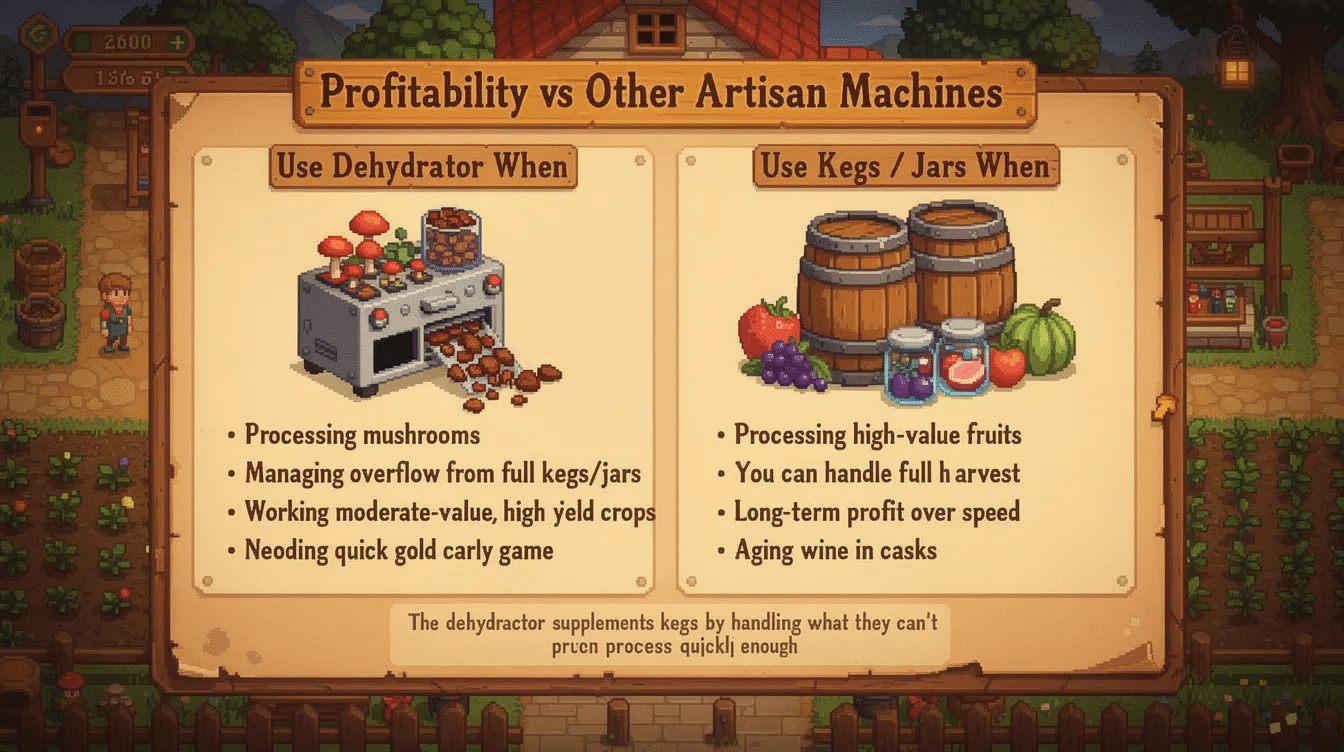
Knowing when to use the dehydrator versus kegs or jars maximizes your overall farm profit. Follow these guidelines:
Choose the dehydrator when:
Processing mushrooms (kegs and jars have limitations with mushrooms)
Managing overflow from full keg/jar production lines
Working with moderate-value, high-yield crops like berries
Needing quick gold turnaround in the early game
Choose kegs or jars when:
Processing high-value fruits like ancient fruit, starfruit, or melons
You have sufficient machine capacity to handle your entire harvest
Maximizing long-term profit matters more than processing speed
Aging wine in casks for additional value multiplication
The dehydrator isn’t meant to replace kegs—it supplements them by handling what they cannot process quickly enough.
Conclusion and Next Steps
The dehydrator offers Stardew Valley farmers a valuable tool for converting surplus fruit or edible mushrooms into profitable dried goods. Its one-day processing time provides flexibility that kegs and jars cannot match, making it especially worthwhile for players managing large harvests or seeking quick early game income.
Take these immediate actions to start using the dehydrator:
Purchase the recipe from Pierre’s General Store for 10,000g (or choose the mushroom cave for a free unit)
Gather 30 wood, 2 clay, and 1 Fire Quartz from the mines
Craft the dehydrator and place it in your processing area
Identify your best candidates—mushrooms, berries, and overflow produce
Maintain daily collection and reloading for maximum throughput
Consider exploring related optimization strategies like integrating the Artisan profession for 40% bonus sale prices, planning seasonal crop rotations around processing capacity, and expanding your dehydrator count as your farm produces more harvest than your kegs can handle. Raisins also serve as valuable gifts and Junimo Hut snacks, opening additional uses beyond pure profit.
Disclosure: This article may contain affiliate links. We may earn a commission if you make a purchase through these links.
DannyContent Writer
Hey there, since 2016, my mission has been to provide you with the information and guides you need to make food dehydrating simple and fun. Whether you're a newbie or a seasoned pro, my site offers helpful guides, reviews, and recipes to enhance your dehydrating experience. I take pride in only recommending products I believe in, ensuring my readers' trust. As an affiliate of various programs, including Amazon Associates, your support helps me continue providing quality content. Thanks for stopping by, and happy dehydrating!