We earn a commission if you make a purchase, at no additional cost to you.
09/22/2026 04:39 pm GMT
🍊 Dehydrated Food Info Finder — Temperatures & Drying Times
Choose a category, then pick a food to see its drying temperature and time.
⚠️ Safety Disclaimer: Drying times are estimates and vary based on slice thickness, food moisture content, humidity, and your dehydrator model. Always check for doneness before storing — food should feel dry, leathery, or brittle with no moist spots. Improperly dried food can harbour mould and bacteria. For meat and poultry, follow USDA safe internal temperature guidelines: beef and pork to 160°F (71°C), poultry to 165°F (74°C). Use a food thermometer when in doubt. Store all dehydrated foods in airtight containers in a cool, dark place and discard anything showing moisture, mould, or off odours.
Beef Jerky Drying Times: Exact Hours, Temperatures, and Safety Guidelines
Making beef jerky at home is one of the most rewarding ways to create a portable, protein-packed snack. But the difference between safe, perfectly chewy jerky and a batch that’s either dangerously underdone or dry as cardboard comes down to one thing: getting your drying time right. This guide covers the exact hours, temperatures, and safety rules you need for every method.
Key Takeaways
Most beef jerky dries in 4–8 hours at about 160°F (71°C). Thinner 1/8–1/4 inch strips finish closer to 4–6 hours, while thicker slices can take up to 8 hours or more.
For food safety, all homemade jerky-including ground meat jerky-must reach an internal temperature of 160°F before or during the drying process to prevent foodborne illness from pathogens like E. coli and Salmonella.
A food dehydrator set to 155–165°F offers the most predictable beef jerky drying times, while ovens, smokers, and air dryers tend to be slower or less consistent.
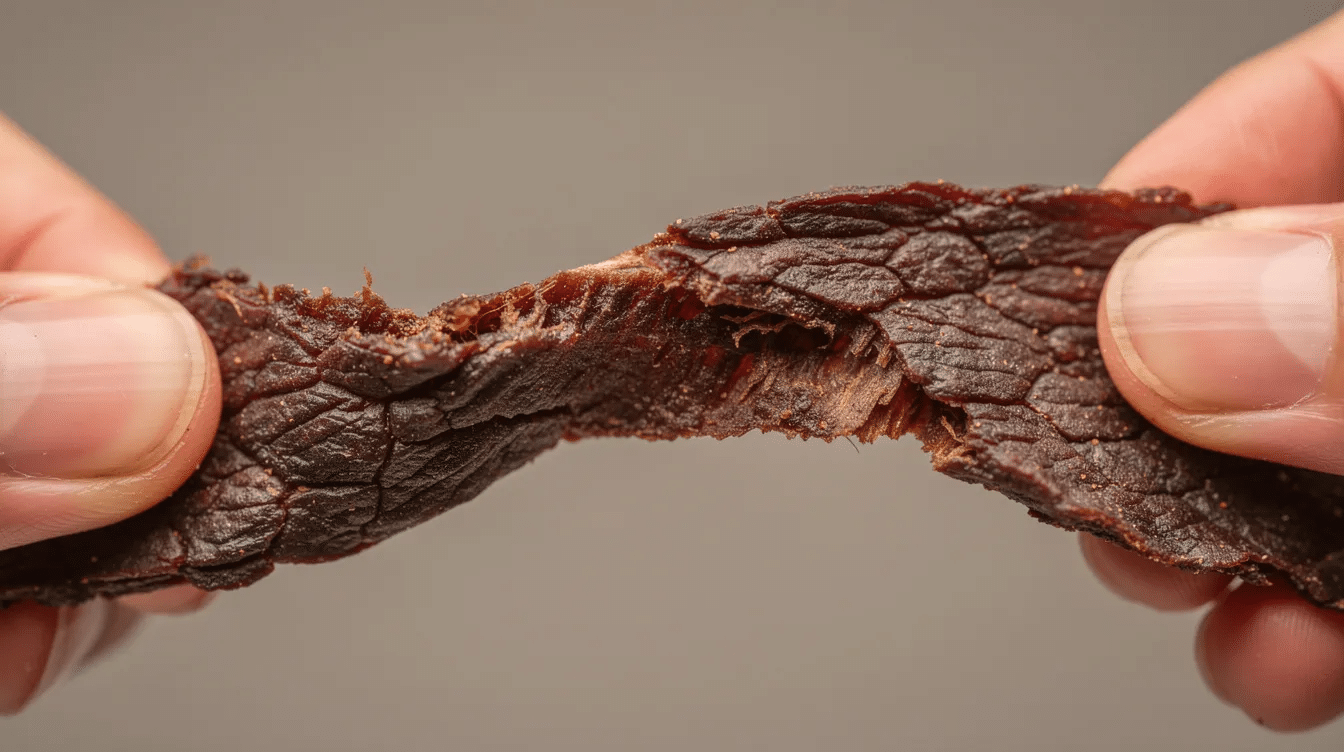
Proper doneness is tested by the “bend and crack” method: jerky should bend and show fine cracks on the surface but not snap cleanly in two, with no visible moisture remaining.
This article covers method-specific drying times, how slice thickness and humidity change your timeline, and best practices for safe home food preservation.
What Is Beef Jerky and Why Drying Time Matters
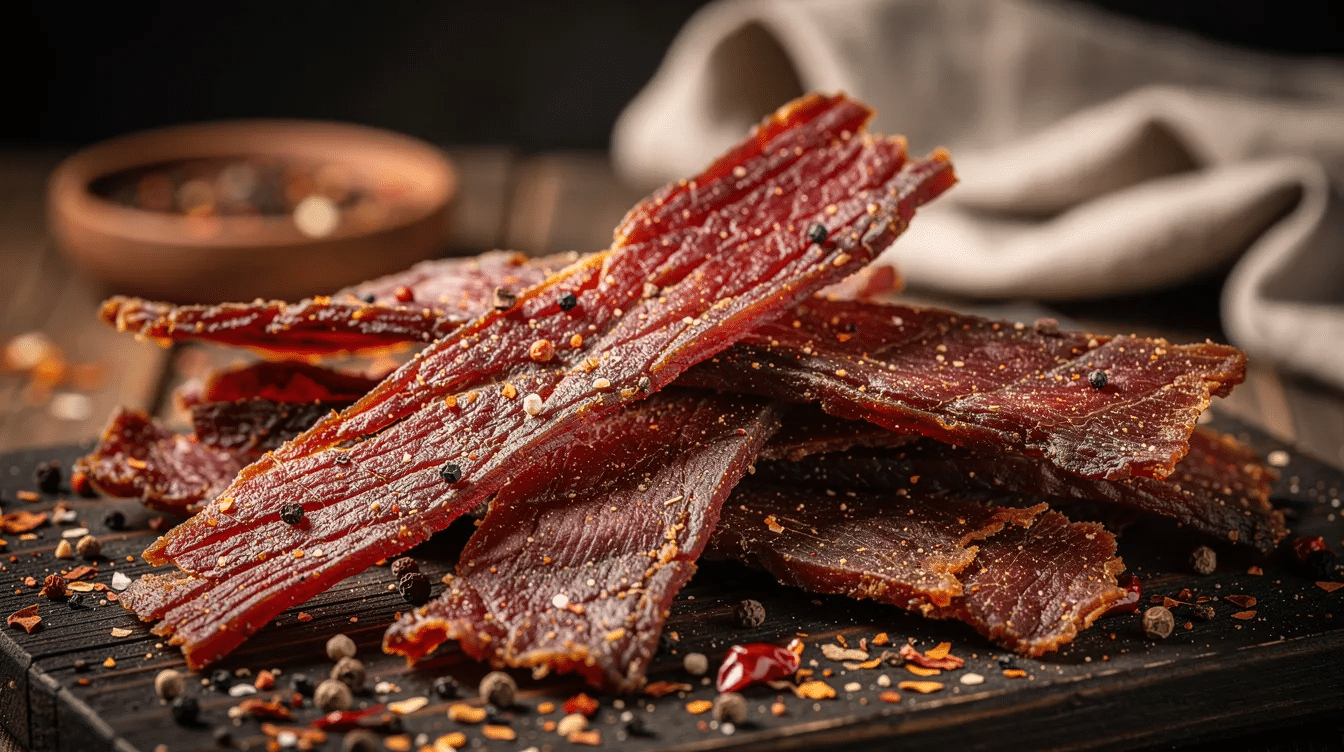
Beef jerky is lean meat that has been salted, seasoned, and dried to remove enough moisture to prevent spoilage. It’s a handy food with ancient roots-from Native American pemmican to African biltong-valued for its portability, high protein content, and long shelf life.
Making beef jerky involves removing moisture until the meat is dry and leathery, which concentrates flavor and creates an environment where harmful bacteria cannot thrive. But “drying time” is not just about convenience or fitting a batch into your afternoon. It directly affects three things:
Safety: Insufficient drying leaves enough moisture for pathogens to survive and multiply, creating a real risk of foodborne illness.
Texture: Too little time produces soft, perishable strips. Too much time creates brittle pieces nobody wants to chew.
Shelf life: Properly dried jerky stores for weeks or months. Under-dried jerky can develop mold within days.
The distinction between homemade jerky and commercial products matters here. Commercial jerky is produced under strict process controls with validated time-temperature curves and lab-tested water activity levels. Home food preservation lacks those industrial safeguards, so you need to manage time and temperature carefully yourself.
Different methods-food dehydrator, oven, smoker, air drying-operate in overlapping temperature ranges but produce different drying times and textures. The rest of this article gives you precise hour ranges and temperatures for each.
Typical Drying Time Range for Beef Jerky (Quick Reference)
Recommended drying times for beef jerky generally range from 4 to 8 hours, though this window shifts depending on method, temperature, and conditions. Drying jerky typically takes about 4 to 10 hours depending on conditions. Here’s a quick breakdown for standard 1/4-inch thick whole-muscle meat strips:
Food dehydrator at 155–165°F: approximately 4–6 hours. This is the most predictable method for consistent results.
Oven drying at 160–175°F: approximately 4–7 hours. Oven hot spots and limited airflow can stretch this range.
Smoker at 140–165°F: approximately 6–10 hours. The lower temperature end and added smoke humidity slow things down.
Controlled air drying at 60–80°F with low humidity: approximately 12–48 hours. This carries significantly higher risk and requires expertise and careful environmental control.
Drying times vary with temperature and slice thickness, so these ranges assume properly spaced beef slices of uniform thickness. Drying time depends on drying method and equipment used-a high-end dehydrator with strong fan circulation will outperform a budget model without one.
Jerky made from 1/4-inch slices typically dries in 4–6 hours in a dehydrator at the recommended temperature range, though overall dehydrating time can vary from about 4 to 15 hours depending on meat thickness, method, and conditions. Ground meat jerky of the same thickness often dries slightly faster than whole-muscle strips due to its more uniform, porous structure, but still usually falls within a 4–8 hour window.
These are approximate drying times. You must always confirm doneness by texture and safety checks, not the clock alone.
Core Food Safety Rules for Drying Meat at Home
Raw meat can harbor dangerous pathogens including E. coli O157:H7, Salmonella, Listeria monocytogenes, and Staphylococcus aureus. When you dry food at low temperatures without proper kill steps, these organisms can survive on or inside the dried meat, especially in ground products where fecal bacteria and other contaminants may be distributed throughout.
The USDA guideline is straightforward: meat used for jerky should be heated to an internal temperature of 160 f (71°C) for beef and other red meats, or 165 f for poultry, at some point before or during the drying process. Pre-heating meat to 160°F eliminates harmful bacteria that would otherwise survive the low, slow dehydration phase.
Many older dehydrators cannot reliably reach these internal temperatures on their own. Dehydrators should maintain a temperature of 130°F to 140°F at minimum, but for food safety, you should pre-heat raw meat in an oven preheated to 275–300°F until the center reaches 160°F, then transfer to the dehydrator for drying.
Safety recommendations emphasize adequately heating the meat to reduce harmful bacteria. Here are essential safe-handling practices:
Keep meat refrigerated until marinating; marinate meat in the refrigerator, never on the counter.
Do not reuse raw marinade that has contacted uncooked meat.
Wash hands, cutting boards, and equipment thoroughly after handling raw meat.
Preheat meat to 160°F to eliminate pathogens before drying.
Safe drying time is always a combination of temperature, time, and low water activity. Longer dry times at low temperatures are not a substitute for hitting 160°F internally.
Understanding Temperature vs. Drying Time
Temperature significantly affects drying speed and safety of jerky production. Higher temperatures speed up water loss during drying because temperature increases the kinetic energy of water molecules, causing faster evaporation from the meat’s surface and interior.
However, cranking the heat too high creates a problem called case hardening. Case hardening occurs when meat is cooked too fast on the outside, sealing the surface before interior moisture has a chance to migrate outward. The result is jerky that looks and feels done on the outside while the center remains dangerously moist.
Ideal jerky drying happens in a moderate heat range-typically 130–170°F depending on method and whether you’ve used a pre-heating step. Within that range, moisture moves steadily from the center of each strip to the surface, where it evaporates into circulating air.
Here’s how temperature maps to time for similarly cut 1/4-inch strips with good airflow:
130–140°F: 8–12 hours (too slow for reliable pathogen kill without pre-heating)
155–165°F: 4–8 hours (the recommended safety range for drying)
170–180°F: 3–5 hours (faster, but edges may over-dry or cook)
Drying time depends on temperature, but time charts always assume properly spaced strips, consistent temperatures, and uniform slice thickness. Deviations in any of these extend your timeline substantially.
Beef Jerky Drying Times in a Food Dehydrator
A food dehydrator is the most reliable method for making homemade jerky and homemade beef jerky from other meats. If you’re choosing equipment, a dedicated food dehydrator for jerky gives you the combination of consistent airflow, controlled heat, and stackable dehydrator trays that creates predictable, repeatable results batch after batch.
The recommended temperature for food dehydrators is around 155°F to 160°F. Modern units-including popular models like the nesco dehydrator-often include a dedicated “jerky” setting near 160°F. Beef jerky should be dried at 155–165°F for safety according to USDA recommendations.
Drying time ranges for whole-muscle jerky strips:
1/8-inch thin slices: approximately 3–5 hours
1/4-inch standard slices: approximately 4–7 hours
3/8-inch thicker strips: approximately 6–9 hours
Food dehydrators take 4 to 6 hours for drying beef jerky at standard thickness-beef jerky takes 4-5 hours to dry in a dehydrator under ideal conditions. Maintaining a constant dehydrator temperature throughout the drying process is critical, and choosing a reliable meat dehydrator designed for jerky helps keep both temperature and airflow consistent. Fluctuations from opening the unit too often or overloading trays can add an hour or more.
Arrange strips in a single layer on dehydrator trays with space between each piece for air circulation.
Rotate trays every 1–2 hours-most dehydrators have stronger airflow near the fan, causing uneven drying.
Check multiple pieces in different parts of the dehydrator. Some strips will finish 30–60 minutes before others.
Place strips so they don’t overlap or touch edges of neighboring pieces.
Beef Jerky Drying Times in a Home Oven
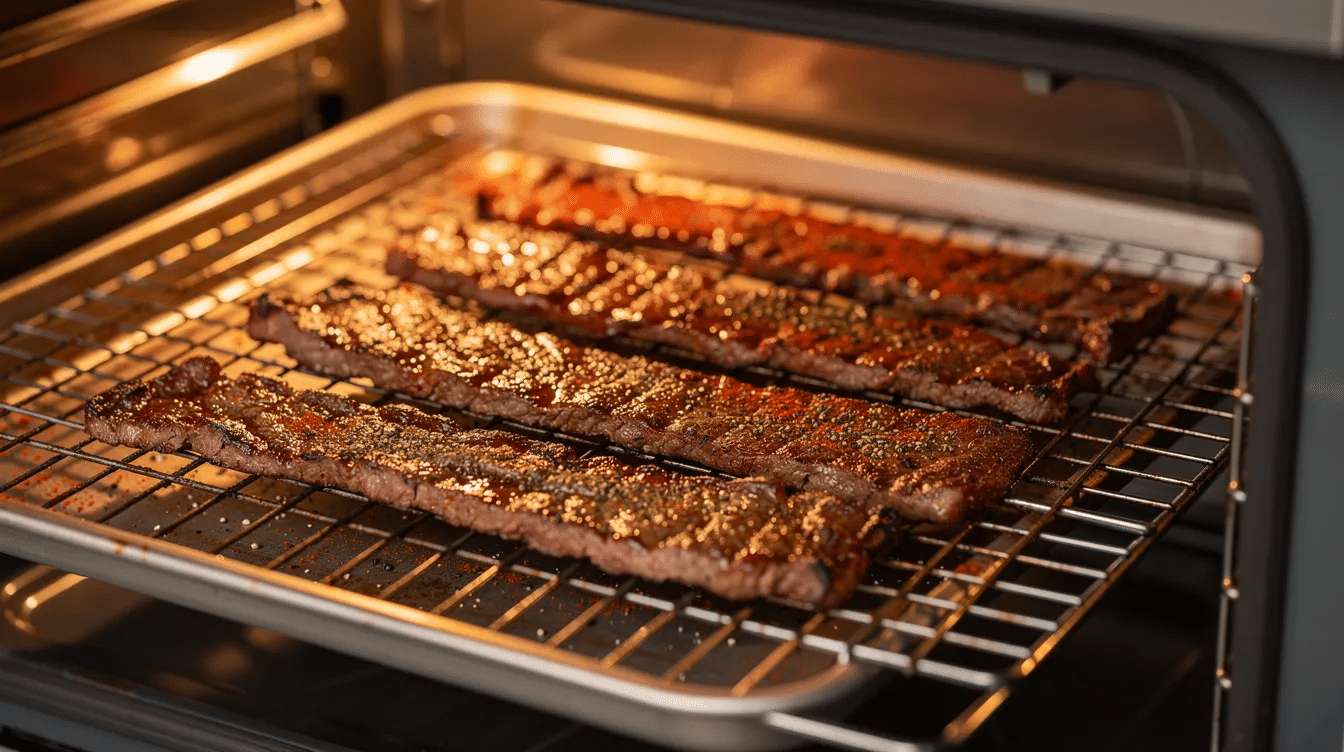
Most home ovens can dry beef jerky effectively, though the oven method requires more attention than a dehydrator. The typical temperature for oven drying is 145°F to 170°F, set as low as your oven allows with the door propped slightly open (about 2–3 inches) to vent moisture.
Drying time ranges for 1/4-inch slices:
At 160°F: approximately 4–6 hours
At 170–175°F: approximately 3.5–5.5 hours, but with higher risk of over-drying edges if not monitored closely
Oven drying takes 4 to 6 hours or longer for beef jerky, and oven drying takes 4-8 hours depending on thickness and oven accuracy. One challenge with ovens is hot spots-areas near heating elements run hotter, causing some jerky strips to finish 30–60 minutes earlier than others. Check and remove pieces individually as they reach doneness rather than pulling everything at once.
Setting up your oven for jerky:
Place racks or cake racks over rimmed baking sheet pans to allow air to circulate above and below the meat.
Arrange strips with enough space between them to prevent steaming. Crowded strips trap moisture and extend drying significantly.
Use an oven thermometer to verify actual temperature-many home ovens run 15–25°F off from the dial setting.
Prop the door open with a wooden spoon or rolled towel to allow humid air to escape.
Ovens that cannot be set lower than 180–200°F are not ideal for dehydrating meat. If that’s all you have, shorten your drying time expectations, check frequently, and accept that finished jerky will have more of a cooked meats texture-firmer and less traditionally chewy.
Drying Beef Jerky in a Smoker: Times and Temperatures
Smokers offer something no other method can: a deep smoky flavor that permeates the meat during the drying process. Smokers dry and flavor jerky simultaneously using low, indirect heat and wood smoke, typically operating between 140–170°F.
Drying time estimates for 1/4-inch whole-muscle strips:
140–150°F: approximately 8–12 hours
155–165°F: approximately 6–10 hours
Smoking beef jerky typically takes 5 to 8 hours at low temperatures under favorable conditions, though many real-world sessions run longer. Heavier smoke and higher humidity inside the smoker slow evaporation, so managing your dampers and vents matters for both smoke intensity and moisture removal.
The internal temperature still needs to reach 160°F at some point. A practical approach: pre-heat jerky strips in an oven preheated to 275°F until internal temp hits 160°F, then transfer them to the smoker for 3–5 hours of drying and smoke exposure. This gives you the safety of a heat kill step and the flavor of real smoke.
Sugar-heavy glazes and thick barbecue sauces can lengthen drying times by creating sticky, moisture-trapping surfaces. Apply these lightly or toward the final hour of smoking. A dry rub with smoked paprika, garlic, and black pepper gives plenty of flavor without the sticky surface problems.
Air Drying and Sun Drying Jerky: Extended Times and Risks
Open-air or sun drying of beef jerky is traditional in certain cultures and climates, but sun or air drying is not recommended for food safety standards by modern guidelines. The extended timelines and variable conditions make it the highest-risk home method.
Air drying beef jerky can take 12–48 hours in a cool, dry environment (60–80°F) with good airflow and relative humidity under about 50%. These long drying times at low temperatures give pathogens far more opportunity to grow unless salt content is extremely high and conditions are controlled with precision.
Sun drying adds even more risks:
Fluctuating temperatures throughout the day and into the evening
Insects and airborne contaminants
Uneven drying from inconsistent sun exposure
No reliable pathogen kill step at ambient temperatures
For average home jerky makers, air drying should be treated as an advanced, niche method-something to explore only after mastering dehydrator, oven, or smoker techniques. If you must try it, use heavily salted thin strips in a screened, well-ventilated area, and expect to monitor conditions closely for the entire 12–48 hour window; watching step‑by‑step jerky dehydration videos can also help you visualize proper drying conditions.
How Slice Thickness Changes Beef Jerky Drying Time
Drying time depends on thickness of meat slices more than almost any other single variable. Thicker meat requires longer drying time due to the greater distance moisture must travel from the center to the surface before it can evaporate.
Thicker jerky slices can increase drying time by 50% or more. Thicker cuts can double the drying time or require an extra 2 to 3 hours compared to standard-thickness strips.
Recommended slicing thicknesses:
1/8 inch (3 mm): fast-drying, relatively crisp jerky. Thinly sliced meat dries rapidly, often finishing in 3 to 4 hours.
3/16–1/4 inch (4–6 mm): the sweet spot for balanced chew and typical 4–6 hour dry times. Slice meat into strips no thicker than ¼ inch for best results.
Thicker than 1/4 inch: only for experienced users willing to dry longer, test more carefully, and accept higher risk of uneven results. Thicker slices take longer to dry compared to thinner slices across every method.
Drying time can be affected by the thickness of the meat in non-linear ways-it’s not just proportional. A strip twice as thick may need more than twice the time because the moisture gradient from center to surface becomes steeper.
Slicing with the grain versus across the grain affects perceived chewiness but doesn’t change drying time as much as actual thickness does. With-grain slices produce tougher, chewier jerky; cross-grain slices tear more easily when eating.
To get uniform slices, use a sharp knife and partially freeze the meat first. Freezing meat for 1-2 hours aids in easier slicing by firming up the muscle fibers so your knife glides through cleanly. All strips in a batch should be as similar in thickness as possible. When some pieces are 1/8 inch and others are 3/8 inch, the thin ones will be over-dried and brittle before the thick ones are safe.
How Fat Content and Meat Cut Affect Drying Time
Fat does not dry the same way water does. While water evaporates under heat and airflow, fat can melt and render but residual fat remains oily, eventually going rancid. Fat content affects drying; leaner cuts dry faster than marbled cuts, producing jerky that stores longer and tastes better over time.
Recommended beef cuts for jerky:
For best results, focus on the leanest beef cuts for jerky so drying times stay predictable and finished texture is pleasantly chewy rather than greasy.
Eye of round – extremely lean, uniform, and ideal for beginners
Top or bottom round – widely available and affordable
Round steak – slightly more connective tissue but still lean
Round roast – buy whole and slice yourself for maximum control
Sirloin tip – lean with good flavor
These are all lean cuts from the round or loin, which dry predictably and slice uniformly. Once you’ve selected a cut, you can follow a step‑by‑step beef jerky dehydrator recipe to handle marinating and drying. Marbled cuts like chuck or ribeye slow drying by up to 20% and can create soft, greasy spots even after long dry times.
Trim all visible fat from meat before slicing-including fat caps, seam fat, and silverskin. The goal is to start with as little fat as possible. After trimming, you’re working with lean meat that will dry evenly and store well.
Ground Meat Jerky: Special Safety and Time Considerations
Ground meat jerky is made from seasoned ground beef or other ground meat, pressed through a jerky gun or shaped by hand into thin strips or sticks. It’s popular because it’s affordable, easy to season uniformly, and doesn’t require careful knife work.
However, ground meat has higher food safety risks than whole-muscle jerky. When beef is ground, any surface bacteria get mixed throughout the product. In whole-muscle strips, pathogens are primarily on the surface where heat reaches them first. In ground beef jerky, harmful bacteria can be buried deep inside where drying heat reaches them last.
Recommendations for safe ground meat jerky:
Use very lean ground beef (90–95% lean) to reduce grease and speed drying.
Pre-cook ground meat to 160°F before forming and drying when possible. This eliminates the guesswork about internal temperature.
If not pre-cooking, use a dehydrator or oven at 155–165°F and plan for longer drying.
For 1/4-inch thick ground meat strips at 160°F in a dehydrator, expect 4–6 hours typically, sometimes up to 7–8 hours if humidity is high or strips are thicker. Studies on ground-formed jerky demonstrate that at lower temperatures (135°F), achieving a safe 5-log pathogen reduction can take 10–16 hours depending on fat content.
Texture and structure differ from whole-muscle jerky. The bend test may look slightly different-ground jerky tends to be more crumbly at the edges-but it should still show dry, crack-prone, non-greasy strips with no soft or moist centers. Blot any surface grease with a paper towel during and after drying.
The Role of Marinades, Salt, and Sugar in Drying Time
A good jerky marinade adds flavor, but it also adds moisture. Marinades affect drying by adding moisture that needs to evaporate-a soy sauce-based marinade, for example, introduces liquid that your dehydrator or oven must remove on top of the meat’s natural water content.
Marinate meat for 6 to 24 hours for best flavor absorption. A standard approach is to prepare your marinade ingredients-soy sauce, Worcestershire, garlic, pepper, and whatever seasonings you prefer-then marinate meat in the fridge overnight, following proven dehydrator jerky marinades and recipes if you want reliable flavor. Longer marination doesn’t dramatically change drying time, but very wet marinades may require extra draining to avoid extending dehydrator times by 1–2 hours.
High salt and sugar concentrations can actually speed effective drying by drawing water out of meat cells through osmosis, even while the marinade adds some liquid externally. However, sugar-heavy glazes or sticky sauces applied during drying can form tacky surfaces that feel wet even when interior moisture is low, making doneness harder to judge.
If you marinade prior to drying, drain the strips thoroughly and pat them dry before loading onto trays. This simple step can shave meaningful time off your total drying process.
Keep notes on each batch-record your marinade recipe, meat weight, slice thickness, and observed drying time. After two or three batches, you’ll know exactly how to adjust liquid levels for more predictable results.
Environmental Factors: Humidity, Airflow, and Altitude
Dehydrating meat is essentially controlled water evaporation. Three environmental factors influence how fast moisture leaves the meat: ambient humidity, airflow pattern, and air pressure.
Humidity is the biggest wild card for home jerky makers. Moisture in the air slows evaporation from the meat surface because the surrounding air is already partially saturated. High ambient humidity extends drying times significantly-sometimes by 2–3 hours or more. High humidity slows drying time across every method. Conversely, low humidity allows moisture to leave the meat quickly, shortening your timeline.
Relative humidity affects drying time; in practical terms, drying jerky on a muggy August day with 80% humidity will take noticeably longer than on a dry January afternoon at 30% humidity.
Airflow is equally critical. Airflow should be maintained for even drying and faster moisture removal. Good airflow prevents moisture from accumulating around the meat, whisking away water vapor so that fresh, drier air takes its place. Airflow is crucial; poor airflow can lead to uneven drying, where strips near the fan finish hours before strips in dead spots.
Altitude is a subtler factor. At higher altitudes, water boils at lower temperatures, which can change how oven or smoker heat behaves. This may slightly lengthen drying time and require closer monitoring with a thermometer.
Practical steps for managing environment:
Run a dehumidifier in the room when drying in very damp climates.
Avoid making jerky during heavy rain or in steamy kitchens (after boiling water, running dishwashers, etc.).
Always budget extra drying time when conditions are not ideal.
How to Tell When Beef Jerky Is Done: Texture and Visual Tests
Time charts give you estimates. Your senses tell you when jerky is actually done. The desired texture of jerky affects drying time decisions, so knowing what you’re looking for is essential.
The bend test
Testing doneness includes bending the meat to check for cracking without breaking. Take a cooled strip, hold it between your fingers, and bend it in half. Properly dried jerky should:
Flex and show fine cracks on the surface
Not snap cleanly in two (that’s over-dried)
Not bend limply without cracking (that’s under-dried)
Testing for doneness includes bending the strip to see if it cracks-it’s the most reliable at-home indicator.
Visual signs of done jerky
Color darkens uniformly across the strip
Surface is dry and matte, not shiny or wet
White meat fibers may become visible when bent
No beads of moisture, pooled marinade, or oily sheen remain
Properly dried jerky should not have visible moisture or wet spots anywhere on the surface or interior.
Critical tip: Allow strips to cool for 5–10 minutes before testing. Hot jerky feels softer and more pliable than it actually is once cooled, giving you a false impression of doneness. Test at room temperature for accuracy.
Thicker strips may feel firmer on the outside but should still flex when bent. If they feel spongy, leave moisture on your fingers, or show wet color inside when torn, they need more time.
Using Thermometers and Internal Temperature Checks
There are two separate temperature goals in jerky making, and confusing them leads to unsafe or over-processed results:
Internal temperature of at least 160°F – this is the safety threshold that kills pathogens. Internal temperature must reach 160°F to ensure safety.
Moderate, consistent drying temperature – this removes moisture without cooking the meat into brittleness.
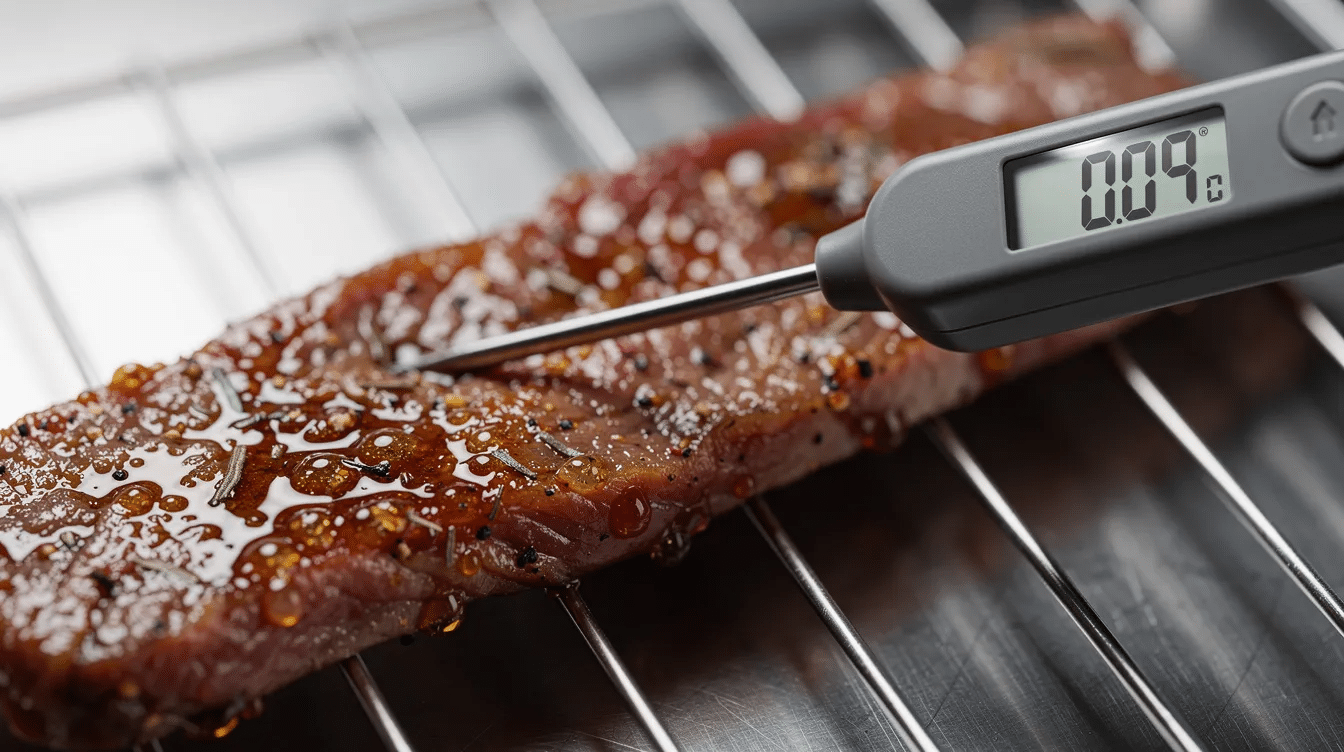
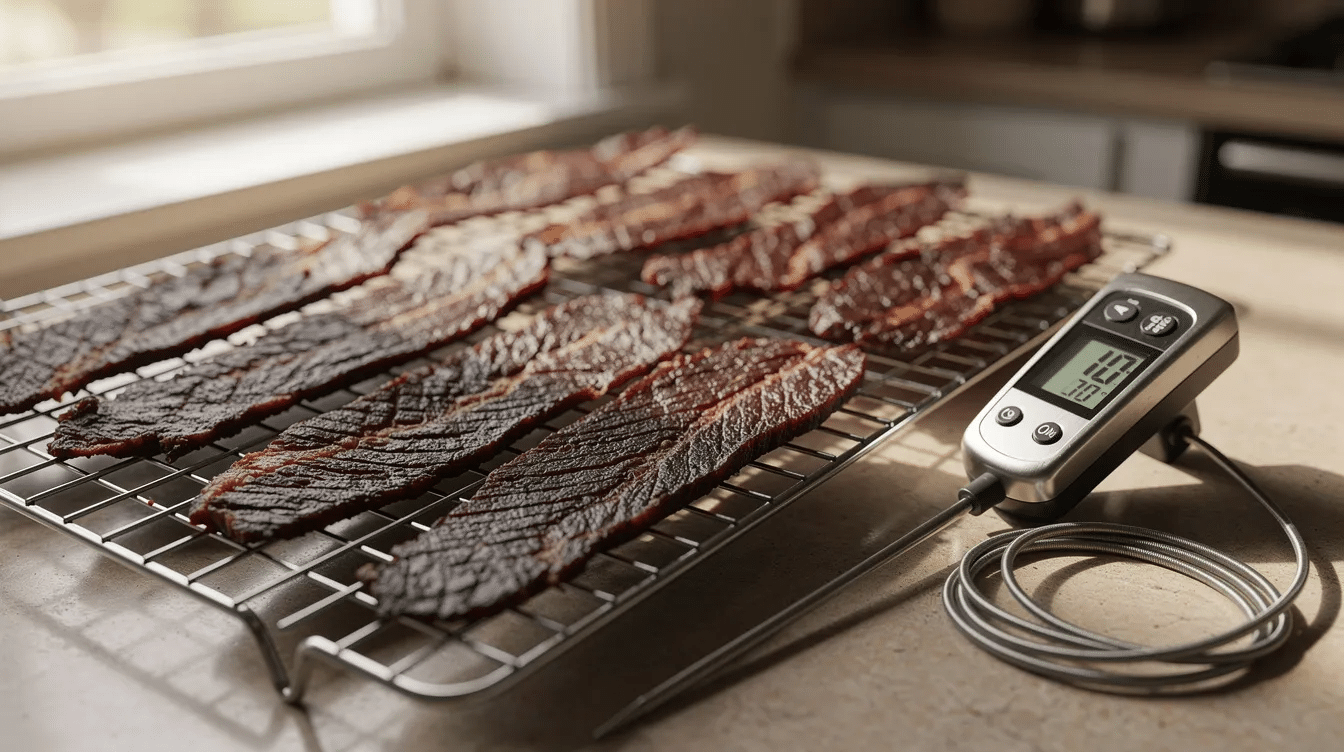
Use a food thermometer-an instant-read or thin probe type-to check internal temperature. With thin jerky strips, insert the probe into the thickest part of a strip, or fold a strip around the probe tip for a reading. Test several representative pieces during the pre-heating or early drying phase.
The recommended two-step process:
Heat meat to 160 f in an oven preheated to 275–300°F until the center of the thickest strips hits 160°F (usually 10–15 minutes for 1/4-inch strips).
Transfer to a dehydrator or smoker at 155–165°F for the remaining 3–6 hours of drying.
This approach separates the pathogen kill step from the dehydration step, giving you confidence in both safety and texture.
Once jerky becomes very dry in later stages, thermometer readings become less reliable because there’s minimal moisture to conduct heat evenly. At that point, texture and visual cues become your primary guides for judging final doneness.
Common Timing Mistakes and How to Fix Them
Even experienced jerky makers run into timing problems. Here are the most frequent errors and how to correct them:
Relying only on a recipe’s stated hours without checking texture. A recipe that says “5 hours” was written for specific conditions that may not match yours. Always verify with the bend test.
Overcrowding trays or racks. When meat strips touch or overlap, moisture gets trapped between them. Some areas remain dangerously moist even after the expected drying time has passed.
Using mixed thicknesses in the same batch. A 1/8-inch strip and a 3/8-inch strip placed side by side will never finish at the same time. Thinner strips become brittle while thicker strips remain unsafe.
Changing temperature mid-process. Dropping temperature to “slow things down” or raising it to “speed things up” without adjusting your time estimate leads to unpredictable results and potential case hardening.
How to fix these issues:
Work in small batches with evenly sliced strips.
Space strips so they do not touch-leave at least 1/4 inch between each piece.
Plan your total time around the thickest strips in the batch.
Keep temperature steady throughout each batch.
Keep a simple log for each batch: method, thickness, temperature, total hours, and your notes on texture. After three or four batches, you’ll have a personal reference that’s more accurate than any generic chart.
How Drying Time Influences Jerky Texture and Chew
The spectrum of jerky textures is directly controlled by drying time (assuming safe internal temperature has been reached):
Shorter drying (4–5 hours at 160°F): softer, moister finished jerky meant for consumption within a few days. Think chewy jerky with a slight give.
Medium drying (5–7 hours): classic leathery texture suitable for storage. This is the dried meat most people picture when they think of jerky.
Extended drying (8+ hours): very dry, sometimes brittle strips more like hard snack sticks. Longer shelf life, but less pleasant to chew.
Minor changes of 30–60 minutes more or less drying can noticeably transform how jerky feels to bite. If you’re making jerky for hiking or camping, slightly drier jerky keeps longer without refrigeration-a benefit when you need to dry food for trail snacks. For same-week snacking, keeping it a bit softer works fine.
Added sugars, honey, or syrups make jerky feel tackier and more pliable at the same drying time. Sugar-heavy recipes may need an extra 30–60 minutes to avoid overly moist, sticky centers that could compromise storage safety.
Sample Timelines for a Batch of Homemade Beef Jerky
Here’s what making homemade jerky actually looks like as a schedule for a 2–3 pound batch of lean beef.
Food dehydrator timeline:
Evening 1: Select a top or bottom round roast. Trim all visible fat. Partially freeze the meat for 1–2 hours, then slice into uniform 1/4-inch strips using a sharp knife. Prepare your jerky marinade and submerge strips in the fridge overnight.
Morning 2: Drain strips, pat dry with a paper towel. Pre-heat strips in an oven preheated to 275°F until internal temperature reaches 160°F (~10 minutes).
Late morning: Place strips on dehydrator trays at 160°F. Arrange strips without overlapping.
Afternoon: Check at 3.5 hours, then every 30–45 minutes. Most strips finish in 4–6 hours. Remove pieces individually as they pass the bend test.
Oven method timeline:
Prep: Same slicing and marinating steps as above.
Morning: Drain and pat dry. Set oven to 160–170°F. Place cake racks or wire racks over rimmed baking sheet pans. Arrange strips in a single layer. Prop door open 2–3 inches.
Drying: Rotate pans every 1.5–2 hours. Beef jerky takes 4–7 hours by the oven method. Check early and often, removing done pieces individually.
Smoker timeline:
Prep: Same trimming, slicing, and marinating process.
Morning: Pre-heat strips to 160°F in the oven. Transfer to smoker set at 155–165°F.
Throughout the day: Maintain steady heat and vent management. Expect 6–10 hours of smoking and drying. Avoid opening the smoker frequently. Manage fire and wood additions to prevent temperature swings.
Build your personal baseline with one or two carefully observed batches before attempting large quantities. Every setup performs a little differently.
Storing Jerky After Drying: How Time Affects Shelf Life
The more thoroughly jerky is dried (within reason), the longer it stores safely. Properly dried jerky with low water activity is shelf-stable far longer than under-dried batches.
Realistic storage timeframes for home dried jerky:
Room temperature in an airtight container: home-dried jerky lasts 1-2 months at room temperature when stored properly.
Refrigeration: extends jerky’s shelf life to 3-4 months.
Freezer: freezing jerky can preserve it for 6-12 months, especially when vacuum sealed and kept consistently cold.
Store jerky in airtight, vacuum sealed bags or glass jars. Store jerky in a cool, dark pantry for optimal shelf life-heat and light accelerate fat oxidation and flavor degradation.
You can freeze jerky in portioned amounts so you only thaw what you need. Vacuum sealed bags are ideal because they remove air that causes freezer burn.
Insufficiently dried jerky may look and feel fine on day one but develop mold, sliminess, or off-odors within days, especially if it isn’t stored correctly in the fridge or freezer as recommended in homemade beef jerky storage and fridge‑life guidelines. This underscores why slightly longer drying-an extra 30–45 minutes past the bend test-can be a worthwhile insurance policy.
Label each batch with the production date and storage method, and compare your timelines with detailed beef jerky shelf‑life and expiration guidance so you know when to discard older snacks. Check periodically for condensation inside bags or containers, which signals under-drying or moisture reabsorption from the environment.
Adjusting Drying Times for Other Meats: Venison, Pork, and Poultry
While this article focuses on beef jerky, many home food preservation enthusiasts also make jerky from venison, pork, and poultry. Each has its own safety and timing considerations.
Venison from wild game (including deer carcasses processed at home) behaves similarly to beef when sliced to the same thickness, but wild game often starts with higher bacterial loads from field dressing and transport conditions. This makes strict adherence to the 160°F internal temperature even more critical. Any venison that has not been rapidly chilled and properly handled in the field should be treated with extra caution. Lean venison dries in roughly the same 4–6 hour window as comparable beef cuts.
Pork jerky must also reach at least 160°F internally due to the historical risk of trichinella in wild or pasture-raised pork. Domestic pork is far safer than it once was, but the temperature guideline still applies. Pork’s slightly different fat distribution may require modest drying time adjustments.
Poultry jerky-chicken or turkey-requires an internal temperature of 165 f and should be kept poultry refrigerated until ready to marinate. The lighter muscle structure of poultry dries slightly faster than beef in most cases, but the higher safety threshold means you cannot cut corners on the heat kill step.
If you’re working with frozen meat from any species, thaw completely in the refrigerator before slicing and marinating. Partially thawed meat slices unevenly and marinates inconsistently.
Master beef jerky timing first, then adjust drying time upward modestly for each new meat type and re-check doneness cues carefully with your first batches.
Frequently Asked Questions About Beef Jerky Drying Times
These questions address specific timing and safety concerns that come up once people start making homemade beef jerky. If your question isn’t covered above, chances are it’s answered here.
Can I Leave My Dehydrator Running Overnight While Drying Jerky?
Running a modern, well-maintained dehydrator overnight is common practice. Most units-including popular models like a nesco dehydrator-are designed for extended operation. Place it on a stable, heat resistant surface away from curtains, paper, or anything flammable.
That said, start batches early enough that expected drying time ends before you go to sleep when possible. If running overnight is unavoidable, check doneness right before bed and again first thing in the morning to avoid over-drying by several hours. Thinner strips left overnight at 160°F may become unpleasantly brittle.
Never leave an oven or smoker unattended overnight. Both carry higher fire risks than dehydrators due to heating elements, gas flames, or smoldering wood.
What Should I Do If My Jerky Is Still Too Moist After Cooling?
Slightly under-dried jerky often reveals itself after cooling-pieces feel soft, sticky, or show visible moisture when bent or torn. This is recoverable.
Return the strips to your dehydrator, oven, or smoker in a single layer and continue drying in 30–45 minute increments. Re-test with the bend test after each interval until strips crack properly without snapping.
It’s safe to re-dry jerky the same day as long as it has been kept clean and refrigerated during any waiting period. Don’t leave moist jerky sitting at room temperature for hours before putting it back in-bacterial growth can resume quickly in warm, moist conditions.
How Does Doubling the Batch Size Affect Drying Time?
Adding more total meat does not automatically double drying time, but it can increase it if dehydrator trays or oven racks become crowded. Reduced airflow between strips is the main culprit.
When scaling up from 1–2 trays to a full dehydrator or several oven racks, expect to add 30–90 minutes to total drying time and rotate trays more frequently (every hour instead of every two hours).
The key is maintaining space between pieces. If strips are touching or overlapping, some areas will stay dangerously moist even after the rest of the batch appears done. When in doubt, work in small batches rather than one overloaded session.
Can I Use the Same Drying Times for Store-Bought Marinated or Pre-Sliced Meats?
When you store jerky-making supplies like pre-sliced or pre-marinated beef from the grocery store, understand that these products may be thicker, thinner, or wetter than what you’d prepare at home. Published drying times are only rough guides for commercial preparations.
Start with the same temperature ranges (around 160°F) but check early and often. Use texture and visual cues-the bend test, surface dryness, absence of moisture-rather than blindly trusting package directions. Some commercial marinades contain tenderizers and sugars that soften texture and can make jerky appear done on the surface while the center stays moist. Careful bend testing and possibly longer dry times are warranted.
Is There Such a Thing as Drying Jerky Too Long?
Absolutely. While longer drying generally increases shelf life, beef jerky can be dried too long. The result is hard, brittle pieces that are unpleasant to chew, may crack or splinter, and lose much of their appealing texture.
Excessively long drying times at higher temperatures can also darken flavor-producing slightly burnt or overly roasted notes-and cause weight loss beyond what’s needed for safe storage. You’re wasting good meat at that point.
Aim for the point where jerky consistently passes the bend test, then stop. Going 1–2 hours past this point typically offers negligible safety benefit while significantly hurting texture. If you want a longer shelf life, improve your packaging (vacuum sealed bags, cool dark storage) rather than drying the life out of every batch.
DannyContent Writer
Hey there, since 2016, my mission has been to provide you with the information and guides you need to make food dehydrating simple and fun. Whether you're a newbie or a seasoned pro, my site offers helpful guides, reviews, and recipes to enhance your dehydrating experience. I take pride in only recommending products I believe in, ensuring my readers' trust. As an affiliate of various programs, including Amazon Associates, your support helps me continue providing quality content. Thanks for stopping by, and happy dehydrating!